How Long Does It Take to Establish Residency in Puerto Rico?
Every month someone in an expat Facebook group posts some version of the same panicked question: “I landed in San Juan three weeks ago, I signed a lease, so am I a resident now?” The honest answer is that there are several kinds of residency in Puerto Rico, and each one runs on a different clock. This guide walks through each timeline so you know which one matters for your situation.
The Short Answer and Why There Are Several Residency Clocks
When I moved to the island, I assumed residency was one event, like a ribbon-cutting. I would arrive, unpack, and become a “Puerto Rico resident.” What I actually found was a set of separate processes running side by side. Some finished within days. Others took more than a year to settle.
So the real answer to “how long does it take to establish residency in Puerto Rico?” depends on which kind of residency you mean. There is practical residency, which is living here and being treated as a local by landlords, utility companies and your neighbors. There is administrative residency, which covers your driver’s license, voter registration and local ID. And there is tax residency, specifically bona fide residency under federal rules. Tax residency is the one that drives most of the anxiety and most of the money questions.
Practical Residency Can Start in Days
If you are a US citizen moving from the mainland, no visa, no immigration interview and no permit stands between you and living here. You can book a flight, land at Luis Muñoz Marín International Airport, and legally live in Puerto Rico the same afternoon. That is the part that surprises people coming from other expat destinations, where the visa process alone can take months.
In practical terms, your life as a resident starts the moment you sign a lease or close on a home. Once you have an address, you can open a utility account with LUMA for electricity and with AAA for water, set up internet, and start getting mail. A friend of mine moved into a walk-up in Santurce on a Monday. By Friday she had power in her name, a local phone number, and a neighbor who brought her pastelillos because she looked “too tired to cook.” For daily life purposes, she was a resident within a week.
The catch is that none of this, on its own, makes you a resident in the legal or tax sense. A lease and an electric bill are evidence. They are pieces of a case you are building, not a certificate that ends the conversation. It feels anticlimactic, and I remember being annoyed that nobody hands you a welcome card. But once you understand that you are assembling proof over time, the process becomes much less mysterious.
Legal Residency for Tax Purposes Runs on the Calendar Year
Tax residency is where the clock slows down. Under federal rules, being a bona fide resident of Puerto Rico means passing three tests: the presence test, the tax home test and the closer connection test. These are judged per tax year. For most individuals, the tax year is the calendar year, January through December.
So you cannot become a bona fide resident in a few weeks. The question is always whether you qualify for a particular tax year, and the answer often cannot be known with confidence until that year is nearly over. If you arrive in March, you will not know for sure whether you qualify for that year until you can look back at your days, your work setup and your connections as of December.
That is why the most common realistic answer is this: plan on your first full calendar year on the island as the year you can confidently claim bona fide residency. A move-year claim is possible under certain conditions, which we cover below, but it is tighter and needs more care. For a deeper look at the process from start to finish, see How to Establish Bona Fide Residency in Puerto Rico (2027).
Comparing the Different Residency Timelines
Here is how the clocks compare side by side. I wish someone had handed me this the week I arrived.
| Type of Residency | What It Covers | When It Typically Starts | What Controls the Timing |
|---|---|---|---|
| Practical residency | Living here, renting, utilities, daily life | The day you move in | Finding housing and setting up accounts |
| Administrative residency | Driver’s license, local ID, voter registration | Within your first weeks to months | CESCO appointments, document gathering |
| Bona fide tax residency | Federal tax treatment of Puerto Rico income | Judged per tax year, often your first full calendar year | Presence, tax home and closer connection tests |
| Act 60 individual benefits | Local tax incentives under a decree | After your application is approved and residency is met | Application review and residency compliance |
| Domicile | Your permanent legal home | When your intent to stay is clear and documented | Your actions and the evidence you build |
Notice that only the first row runs on your own schedule. Every other row depends on paperwork, agency calendars, or the passage of the tax year. That gap between “I live here” and “I am legally a resident” is the main source of stress for new arrivals, and it helps to know it is built into the system.
How the Presence Test Shapes Your Timeline
If one test determines how long residency takes, it is the presence test. It is the most mechanical of the three, which makes it the easiest to plan around. It is also the easiest to fail through sloppy tracking.
The best-known way to pass is to spend at least 183 days in Puerto Rico during the tax year. There are other ways to satisfy it as well. One averages your presence over a multi-year window with a minimum each year. One limits how many days you spend in the United States. One caps how much earned income you have from US sources. One applies if you have no significant connection to the United States at all. For a plain-language breakdown of all three residency tests together, see Understanding the Three Residency Tests (Presence, Tax Home, Closer Connection).
How Days Are Counted
This is the detail that saves people from miscounting. You are treated as present in Puerto Rico on any day you are physically on the island at any time during that day. That means the day you arrive counts as a full day of presence, and so does the day you leave. This comes from the Treasury regulation on territory residency and is restated in IRS Publication 570, and that is the rule as it stands as of October 2026.
In practice, a weekend trip to Miami that leaves Friday morning and returns Sunday night costs you only Saturday as a non-Puerto Rico day. Friday and Sunday still count because you were on the island for part of each. For frequent travelers, this matters a great deal. I have a neighbor in Dorado who flies to Atlanta for client meetings about twice a month. Once he understood that his departure and return days both count, his projected number of off-island days dropped noticeably.
The flip side is that the counting only helps if you can prove it. Boarding passes, credit card statements showing purchases at Plaza Las Américas or a colmado in Río Piedras, and phone location history all become evidence. Treat your day count like a logbook from day one rather than reconstructing it from memory the following spring. The practical methods are covered in How to Document Your Days in Puerto Rico for the Presence Test.
The 183-Day Path Step by Step
If you are aiming for the most common route through the presence test, here is the sequence I recommend:
- Choose a tracking method before you arrive. A simple spreadsheet, a calendar app, or a dedicated day-counting app all work, as long as you use it consistently.
- Log your arrival day as a Puerto Rico day, since any part of a day on the island counts.
- Record every departure and return with flight details, and keep the boarding passes or confirmation emails in a dedicated folder.
- Keep a running total of Puerto Rico days and a separate total of days spent in the United States, because some alternative versions of the test look at US days specifically.
- Review your count once a month so a busy travel season does not quietly push you toward the line.
- Plan any long trips early in the year, while you still have room to adjust your schedule.
- At year-end, reconcile your log against bank statements and travel records so your numbers hold up if anyone asks.
None of these steps is complicated. The difficulty is doing them every time, including on the trip home for a cousin’s wedding when the last thing on your mind is a spreadsheet.
What a Mid-Year Move Looks Like on Paper
Here is a concrete example, because it clears up a lot of confusion. Say you arrive on July 2 of a given year and stay through December 31 without a single trip off the island. Counting July 2 through December 31 inclusive gives you exactly 183 days, because your arrival day counts as a full day of presence. On paper, you meet the 183-day version of the presence test for that calendar year, with zero margin.
Now say you arrive on July 2 but fly to New York for four days over Thanksgiving. You will fall short of 183 days for that year. Your arrival and return days still count, but the full days in New York do not. Unless you satisfy one of the alternative versions of the presence test, you would not pass it for the move year. That doesn’t ruin your plans. It usually just means your first full calendar year becomes your first clean bona fide residency year.
There is also a special year-of-move rule. Under it, if you have not been a bona fide resident in recent prior years, you can be treated as a bona fide resident for the year you move if you meet certain conditions, including being a resident for the final 183 days of that year. The details matter, and getting this wrong can mean filing incorrectly for your first year. Before you rely on it, read Understanding the Year-of-Move Special Residency Rules in Puerto Rico and talk through your dates with a tax professional who works with Puerto Rico returns.
Tax Home, Closer Connection and the Paper Trail That Takes Longest
The presence test is about your body being on the island. The other two tests are about your life being anchored here. These are the parts that take longest, because they depend on accumulated evidence rather than a day count.
Building Your Tax Home
Your tax home is generally your regular or principal place of business. If you have no regular place of business, it is your regular place of abode. For the tax home test, you need your tax home to be in Puerto Rico for the tax year, which means you cannot have it in the United States or a foreign country.
For employees of local companies, this is usually simple. If you work at a pharma plant in Barceloneta or a bank office in Hato Rey, your tax home is pretty clearly here. For remote workers, it takes more thought. If you work from a home office in Condado for a company based in Chicago, your setup and your travel pattern need to show that your work is actually done here. A dedicated workspace, a local coworking membership and a work calendar that shows you working from the island all help.
I worked remotely when I moved, and the moment it became real for me was when I signed a coworking agreement and started taking client calls from a desk with a view of the lagoon instead of from my old apartment in Philadelphia. That is the kind of practical shift that builds a tax home. If your employer still lists you as based in a mainland office, or you keep spending long stretches working from the mainland, the picture becomes muddier. If your income still flows from a mainland employer, see Can I Keep My Mainland Job and Be a Bona Fide Resident of Puerto Rico? for how those arrangements are usually structured.
Closer Connection Takes Time to Grow
The closer connection test asks whether you have more significant ties to Puerto Rico than to the United States or a foreign country. This is the test that cannot be rushed, because connections build gradually. You cannot sign one form and instantly have a closer connection to the island.
The factors look at where you live permanently, where your family lives, where your personal belongings are, where you bank, where you vote, where you hold your driver’s license, and where your social, cultural and religious life happens. It also looks at what address you list on official documents. Think of it as a scale. Every tie you move here adds weight on the Puerto Rico side. Every tie you leave on the mainland keeps weight on the other side.
Here is the order we suggest for shifting the balance:
- Secure your main home here, ideally with a lease or deed in your own name.
- Move your important belongings, so that what matters to you lives here and not in a storage unit back home.
- Open a local bank account and route your everyday spending through it.
- Get your Puerto Rico driver’s license and surrender your mainland one where the process requires it.
- Register to vote locally and cancel your previous registration.
- Update your address with federal agencies, your financial institutions and your professional bodies.
- Join local life in visible ways: a gym in Guaynabo, a church in Old San Juan, a surf club in Rincón, a volunteer group, a kid’s sports league.
- Reduce or close leftover mainland ties that no longer serve a purpose, such as a mainland gym membership or an unused second address.
The license step usually happens at CESCO, the island’s motor vehicle office, and appointment availability varies by location. The full process is covered in How to Get a Puerto Rico Real ID Driver’s License. For the civic side, see How to Register to Vote After Moving to Puerto Rico, which also covers canceling your old registration so you are not voting in two places.
How long does this take? For most people I know, the core steps come together within the first few months, with some stragglers lasting well into the first year. The single most common delay is keeping one foot on the mainland. That might be a house you have not sold yet, or a spouse who has not moved yet. Those situations aren’t disqualifying in themselves, but they do weaken the closer connection picture, and they deserve a careful look. Understanding the Closer Connection Test for Puerto Rico Residency goes into the weighing in more depth.
Documents to Gather in Your First Months
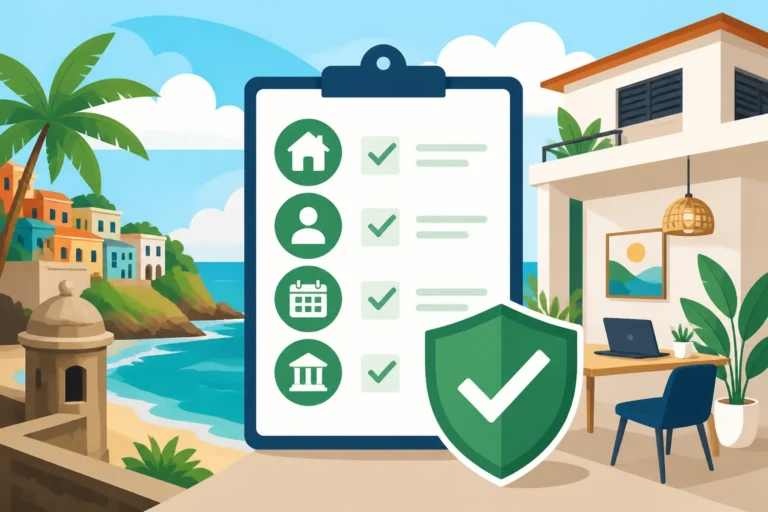
Residency is an evidence game, so the paperwork deserves its own attention. Here is what I would gather and keep in one place, both digitally and in a physical folder:
- Your signed lease or property deed, plus any renewals.
- Utility bills from LUMA, AAA and your internet provider in your own name.
- Local bank statements showing regular activity on the island.
- Your Puerto Rico driver’s license or non-driver ID.
- Your voter registration confirmation.
- Employment records, an employment letter, or business registration showing where you work.
- Travel records: boarding passes, itineraries and passport stamps for any foreign trips.
- Proof of local memberships, such as a gym, coworking space, religious community or club.
- School enrollment records for any children.
- Address change confirmations from federal agencies and financial institutions.
For tax purposes, there is also a federal form, Form 8898, used to notify the IRS when you become or stop being a bona fide resident of a US territory in certain situations. Whether you need to file it depends on your income and circumstances, so confirm with your tax preparer. It is the kind of item that slips through the cracks during a hectic move.
On the health side, keep proof of your coverage as well. It is not a residency test factor in itself, but having coverage that clearly works on the island removes a major source of stress during the transition. If you are coming from overseas, or you spend long periods traveling, an international insurer such as Cigna Global may be worth asking about, because they can explain whether a plan would cover you during the gap before local coverage begins. Check the provider’s own pages for current plan details and whether Puerto Rico falls inside a given coverage area.
Realistic Month-by-Month Timeline and Common Delays
Here is the experience-based version of the timeline, from someone who lived through it and has watched many friends go through it since. Everyone’s pace differs, but the general shape stays the same.
Weeks One Through Four
The first month is all logistics. You arrive, often jet-lagged and sweaty, and you spend your days on the basics. You set up electricity, water and internet, buy a fan you didn’t think you would need, and learn that “ahorita” can mean five minutes or three hours. This phase is the most exhausting, but in residency terms it is the quickest.
From a residency perspective, these weeks are about starting your evidence trail cleanly. Record your arrival day in your presence log. Get your utilities set up in your own name instead of leaving them in a landlord’s name if your lease allows it. Open a local bank account. Many newcomers find that visiting a branch with a passport, a lease and proof of address gets things moving faster than trying everything online.
The moving logistics themselves can stretch this phase if your belongings are still crossing the ocean. Shipping a household to the island usually involves a container or consolidated shipment. Timelines vary with the port schedule, customs, and whether you are moving from the East Coast or farther away. Comparison sites such as Sirelo can help you collect quotes from several movers at once, which saves you making a dozen calls while you are still packing. Getting your belongings here sooner also helps on the closer connection side, because your personal effects being on the island is one of the factors.
Months Two Through Six
This is when administrative residency comes together. You book your CESCO appointment, gather documents, and switch to a Puerto Rico driver’s license. You register to vote. You update your address with the IRS, the Social Security Administration, your brokerage, and anyone else who sends you mail. If you have children, you enroll them in school here, which is a strong practical anchor.
It is also when frustration peaks. Government offices can be slow, appointment slots can be scarce, and some forms are only in Spanish. I remember spending an entire morning at a CESCO office only to learn I was missing one certified document. It felt like a personal attack at the time. Looking back, it was just part of the process, and the second visit went smoothly. Bring extra copies of everything, arrive early, and bring water and patience.
By the end of this phase, most of the closer connection checklist should be complete. Your presence log should show a steady pattern, and your work setup should clearly sit on the island. If you have done all this, you are well positioned to claim bona fide residency for your first full calendar year. That holds even if your move year is borderline.
The First Full Tax Year and Beyond
Your first full calendar year on the island is where everything becomes official in a meaningful way. If you pass the presence test, keep your tax home here and maintain a closer connection to Puerto Rico through December, you are a bona fide resident for that year. You file accordingly with Hacienda and, where required, with the IRS.
Residency also has to be maintained. Each year stands on its own, so you have to pass the tests again every year. A year with heavy mainland travel, a new job based off-island, or a family situation that pulls you back for months can change your status for that year. For more on the consequences of extended trips, see What Happens If I Spend Too Many Days Off-Island from Puerto Rico?.
In my experience, by the second year residency stops feeling like a project and becomes a habit. You still keep your log, you still keep your folder, but you no longer think about it every week. That is the point where Puerto Rico stops feeling like a move and starts feeling like home.
Where Act 60 Fits
Many people researching residency timelines are really asking about Act 60, Puerto Rico’s set of tax incentives that includes benefits for individual resident investors. It is important to separate the two. Act 60 benefits for individuals generally require you to become and stay a bona fide resident. The decree itself is a separate approval process with its own timeline and conditions.
In practice, that means two tracks running side by side. One is your Act 60 application, which is reviewed by the relevant government office and results in a decree if approved. The other is your actual residency, which you build through the presence, tax home and closer connection tests. The decree does not make you a resident on its own, and residency does not grant you a decree on its own. You need both, and they move at different speeds. For a realistic view of the decree process, see How Long Does the Act 60 Decree Process Take in Puerto Rico?.
There are also ongoing compliance obligations once you hold a decree, including annual reporting and other requirements that apply each year. Treat them as part of your residency calendar, not an afterthought, and work with a professional who handles Act 60 cases regularly.
Situations That Stretch the Timeline
Some situations make residency take longer or require extra care. Here are the ones I see most often:
- Foreign nationals. If you are not a US citizen, your ability to live in Puerto Rico depends on US immigration status, because Puerto Rico follows federal immigration law. That means visa or green card timelines come first, before any residency tests even apply. The immigration step can easily be the longest part of the whole journey.
- Split households. If your spouse or children stay on the mainland for a school year or while a house sells, your closer connection picture becomes more complicated. It can still work, but it needs careful documentation and professional advice.
- Frequent travelers. Consultants, pilots, traveling nurses and anyone else who spends large chunks of time off-island need to track days rigorously and may rely on alternative versions of the presence test.
- Remote workers with mainland ties. If your employer’s paperwork, your payroll address or your work pattern still point to the mainland, your tax home may be harder to show.
- Late-year arrivals. Arriving in autumn usually means your move year will not qualify under the standard presence test, so your first full calendar year becomes your target.
- Unsold mainland property. Keeping a home on the mainland, especially one you still use, can weigh against your closer connection to the island.
None of these situations rules out residency. They just mean the clock runs a bit slower and the evidence needs to be a bit stronger. When I talk with friends in these situations, my advice is always the same: start your documentation earlier than you think you need to, and get professional input before filing your first return rather than after.
If you want everything above in one practical, start-to-finish format, keep The Complete Relocation Checklist for Moving to Puerto Rico (2027) open on your laptop during your first months. It is much easier to check items off as you go than to reconstruct your move from memory a year later.
So, how long does it take to establish residency in Puerto Rico? Practical residency starts in days. Administrative residency usually comes together over your first few months. Bona fide tax residency is judged per tax year, so for most people the first full calendar year on the island is the first year they can claim it with confidence. A mid-year arrival can qualify for the move year if the dates and conditions line up. Track your days from the first one, move your life here in visible ways, keep your paperwork organized, and the process becomes far less intimidating than it looks from the departure gate.
Disclaimer
This article is for general informational purposes only and does not constitute professional advice. Laws, prices and regulations vary by location and change over time. Consult a qualified professional for guidance on your specific situation.