How Do I Prove My Tax Home Is in Puerto Rico?
Okay, let's talk about "tax home" in Puerto Rico. This phrase can sound so bureaucratic and intimidating, especially when you're trying to navigate the complexities of establishing yourself here. Many of us expats have stared at IRS forms, scratching our heads, wondering how to really prove we've made this beautiful island our true center of life. This guide is here to walk you through exactly what "tax home" means in the context of Puerto Rico residency and, more importantly, how you can gather the solid evidence needed to prove it.
Understanding the "Tax Home" Concept for Puerto Rico Residency
When you hear "tax home," your mind might jump straight to where you pay taxes, or maybe even just your physical house. But for the IRS, and especially when we're talking about establishing bona fide residency in Puerto Rico, it's a bit more nuanced. It’s not just about paying taxes; it's fundamentally about where your main place of business or employment is, or if you don't have one, where your primary abode is. This isn't just an arbitrary term; it's a crucial piece of the puzzle to distinguish between a temporary stay and a genuine move that qualifies you for Puerto Rico's tax treatment.
What "Tax Home" Really Means to the IRS
The IRS defines your "tax home" as the general area of your main place of business, employment, or post of duty, regardless of where you maintain your family home. If you don't have a regular or main place of business because you're an itinerant worker (traveling constantly), then your tax home is wherever you regularly live. Now, for us who are moving to Puerto Rico, this is incredibly important because it's one of the three main tests for establishing "bona fide residency" here. If you can't satisfy the tax home test, then you likely won't be considered a bona fide resident, which means missing out on those sweet tax benefits. It’s about demonstrating a genuine intention to conduct your primary economic and personal life on the island. Think of it less as a physical address on a piece of mail and more as the core hub of your professional and personal existence.
Differentiating Tax Home from Domicile and Physical Presence
It’s easy to get these terms mixed up, and trust me, many people do! Let's clarify:
- Tax Home: As we just discussed, it's primarily about your economic center. Where do you earn your income? Where are your primary business operations? If you're retired, where do you carry out your daily life activities and manage your affairs? This is about proving that Puerto Rico isn't just a vacation spot or a temporary stopover for your professional life.
- Domicile: This is more about your intent to make a place your permanent home. It's often the place where you intend to return whenever you're absent. You can only have one domicile. Establishing domicile when you move to Puerto Rico involves taking concrete steps that show this intent, like getting a local driver's license, registering to vote, and updating your will. Your domicile is typically a stronger indicator of where you truly belong.
- Physical Presence (The 183-Day Rule): This is the easiest one to understand and prove, but also the most superficial. It simply means you must be physically present in Puerto Rico for at least 183 days during the tax year. It's a headcount, plain and simple. While crucial, simply being here for 183 days doesn't automatically establish your tax home or domicile. You could be a long-term tourist meeting this rule, but without a tax home, you're not a bona fide resident.
You can really dig into these distinctions in guides like Understanding Legal Residency and Domicile in Puerto Rico (2027) or Understanding the Three Residency Tests (Presence, Tax Home, Closer Connection). They all work together, but the "tax home" component is often where people stumble because it requires more than just showing up.
Key Elements and Evidence for Your Puerto Rico Tax Home
Proving your tax home is all about creating a paper trail and demonstrating a clear shift in your center of economic and professional gravity to Puerto Rico. It’s not about one single document, but a collection of evidence that paints a consistent picture for the IRS. Think about everything that ties you to your work and your daily life; that's what you need to document.
Establishing Your Primary Place of Business or Employment
This is often the strongest indicator of your tax home. If you work, what does that look like on the island?
- Local Employment: If you're employed by a company based in Puerto Rico, get a copy of your employment contract, pay stubs from your Puerto Rico-based employer, and any official correspondence. This is gold. It directly shows your income is sourced here.
- Self-Employment/Business Owner: For many of us, this is the path we take. If you’re self-employed, registering your business with the Puerto Rico Department of State and Hacienda is paramount. Get your Merchant Registration (Registro de Comerciante), your Employer Identification Number (EIN) if applicable, and any business licenses. Showing local clients, local business bank accounts, and local expenses (rent for an office, utilities, local suppliers) all reinforce that your business operations are genuinely centered here. This is especially relevant if you're looking into programs like Act 60. You can learn more about this in Self-Employment in Puerto Rico: Registering a Business and Getting Licensed (2027).
- Remote Work: This is where it gets a little trickier, but still doable. If you work remotely for a mainland company, you need to show that your base of operations is definitively Puerto Rico. This means having a dedicated workspace here, using your Puerto Rico address for all work-related correspondence, and establishing that your actual work performance happens on the island. The IRS cares about where the economic activity generating your income occurs, not just where your employer's headquarters are. Update your employer with your Puerto Rico address and have them issue any tax documents to this address.
Demonstrating Your Primary Abode
If you don't have a clear "main place of business" (e.g., you're retired, a passive investor, or your work is truly itinerant), then your primary abode becomes the key. This is about showing where you actually live and manage your personal affairs.
- Residential Property: A lease agreement for a rental property or a deed if you own a home in Puerto Rico is essential. This proves you have a fixed, regular place of residence. The longer the lease term, the better it looks. Utility bills (LUMA, AAA, internet) in your name at that address are also critical. Learn more in The Newcomer's Guide to Setting Up Utilities (LUMA/AAA) in Puerto Rico or The Complete Guide to Renting an Apartment in Puerto Rico (2027).
- Local Bank Accounts: Open bank accounts with local institutions like Banco Popular or Oriental Bank. Use these accounts for your daily expenses, income deposits, and bill payments. The more financial activity you have through Puerto Rico banks, the more clearly your financial life is centered here. The Newcomer's Guide to Opening a Bank Account in Puerto Rico is a great resource.
- Vehicle Registration and Driver's License: Transferring your vehicle registration to Puerto Rico and obtaining a Puerto Rico driver's license are strong indicators. These show you're integrating into the local infrastructure and intend to stay.
- Mail and Correspondence: Change your mailing address for all personal and professional correspondence to your Puerto Rico address. This includes bank statements, credit card bills, investment statements, and subscriptions. Using a mail forwarding service like those found via Sirelo during your initial transition can be helpful, but eventually, everything needs to point to your new island address.
- Community Involvement: While harder to document, participating in local community groups, volunteer work, or even joining a local gym demonstrates that your personal life is rooted here.
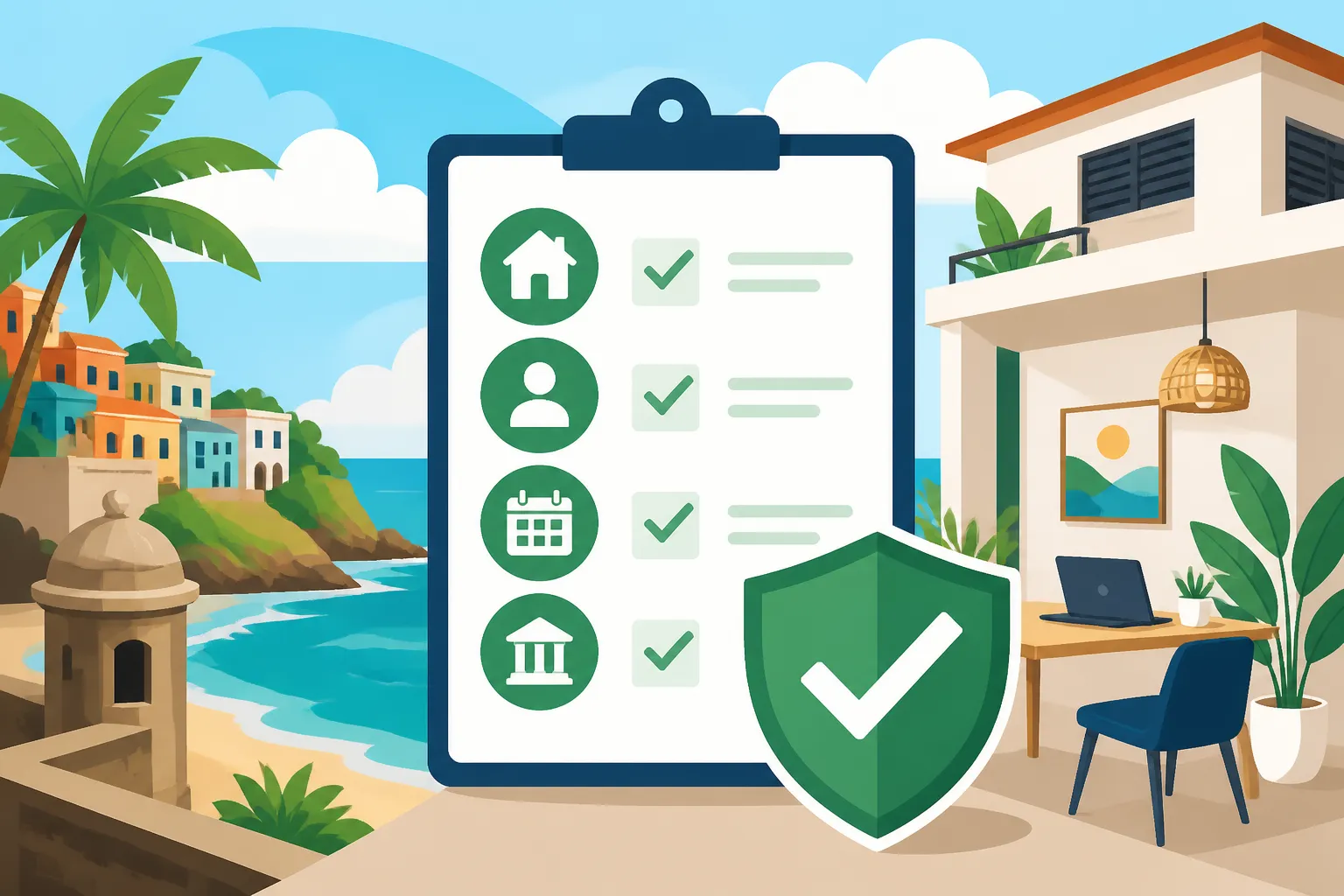
Here’s a table summarizing key evidence:
| Type of Evidence | Description | Strength |
|---|---|---|
| Employment/Business Docs | Puerto Rico employment contract, pay stubs, business registration, licenses, local client invoices, local business expenses. | High: Directly shows economic center. |
| Residency Documents | Lease agreement (long-term), property deed, utility bills (LUMA, AAA, internet) in your name. | High: Demonstrates a fixed personal abode. |
| Financial Records | Local bank statements (checking, savings), credit card statements with PR address, investment accounts managed from PR. | Medium-High: Shows financial integration. |
| Official IDs | Puerto Rico driver's license, non-driver ID, voter registration. | Medium-High: Shows intent to reside. |
| Vehicle Documents | Puerto Rico vehicle registration, local insurance (ACAA). | Medium: Indicates local transportation. |
| Healthcare & Personal | Enrollment in Puerto Rico health plans (e.g., through Cigna Global or local providers), local doctor/dentist records, gym memberships, local club memberships. | Medium: Shows integration into daily life. |
| Mail & Subscriptions | Official correspondence, magazine subscriptions, bills mailed to your PR address. | Medium: Confirms PR as mailing address. |
| Family Ties (if applicable) | Enrollment of children in local schools, local family doctor. | Medium-High: Strong emotional/social ties. |
Navigating the Nuances: When Your Tax Home Gets Tricky
Sometimes, life isn't a straight line, and neither is establishing your tax home. You might find yourself in situations where proving your ties to Puerto Rico feels a bit more complicated. These are common concerns, and while they add layers, they don’t necessarily disqualify you. It just means you need to be even more meticulous with your documentation.
Still Owning Property or Having Ties on the Mainland
This is a big one. Many people moving to Puerto Rico still own a home or maintain some ties on the mainland, at least initially. The IRS understands that transitions take time, but they also want to see a clear severance of your economic ties to your former location and a strengthening of your ties to Puerto Rico.
- Renting out Mainland Property: If you own a home on the mainland, actively renting it out can show that it's no longer your primary abode. Have a formal lease agreement and show rental income.
- Selling Mainland Property: Ideally, selling your mainland home completely removes that tie. If you can, do it. If not, be prepared to explain why it's not your tax home (e.g., it's an investment property, or it's held for a relative, and you have no personal use of it).
- Mainland Bank Accounts: It's okay to keep mainland bank accounts, especially for legacy payments or if you have specific mainland investments. However, the bulk of your daily banking activity, income deposits, and bill payments should shift to your Puerto Rico accounts. Show consistent and significant financial activity through your local banks.
- Family Members Remaining on Mainland: This is tough. If your spouse or dependents still live on the mainland, it can weaken your "closer connection" and potentially your "tax home" argument, as the IRS often looks at the family unit. If this is your situation, ensure your individual economic and personal ties to Puerto Rico are overwhelmingly strong and well-documented.
The key here is intent and action. Your actions must clearly demonstrate that your primary life, both professionally and personally, is now on the island, even if some residual ties remain elsewhere.
Frequent Travel for Work or Personal Reasons
Life in Puerto Rico often means a bit more travel, whether for business or to visit family on the mainland. This can complicate the "tax home" and "physical presence" tests.
- Documenting Travel: Keep meticulous records of your travel dates, including flight itineraries, boarding passes, and passport stamps (if traveling internationally). You need to prove you're present in Puerto Rico for at least 183 days each year. Tools or apps that track your location can be helpful, but be mindful of privacy.
- Business Justification: If you're traveling frequently for work, ensure your employer (or your own business) can provide documentation justifying the travel and confirming that your base of operations is Puerto Rico. Show that the travel is from your Puerto Rico tax home, not to it.
- Maintaining Your Puerto Rico Abode: Even when traveling, your Puerto Rico home must remain your continuous and principal place of residence. Don't let your mainland residence (if you still have one) appear more "lived-in" or central to your life. The Understanding the 183-Day Rule for Bona Fide Residency in Puerto Rico guide offers more details on managing your travel.
The "Closer Connection" Test (Related but Distinct)
While technically separate from the "tax home" test, the "closer connection" test often comes into play, especially if your tax home is hard to define or if you spend significant time outside Puerto Rico. It serves as a tie-breaker. It looks at various factors to determine if your ties to Puerto Rico are closer than to any other location. Many of the same documents used for "tax home" proof will also help here:
- Home/Abode: Where is your permanent home located?
- Family: Where do your immediate family members live?
- Personal Belongings: Where are your personal belongings (cars, furniture, pets) located?
- Social & Community Ties: Where do you have social, cultural, religious, or political affiliations?
- Driver's License & Voter Registration: Where are you licensed to drive, and where are you registered to vote?
- Bank Accounts: Where do you have banking relationships?
- Professional Licenses: Where do you hold any professional licenses?
- Health Insurance: Where do you have your primary health insurance coverage? (This is where a plan from a provider like Cigna Global, tailored to expats, can show your intent for international/local coverage).
The more you can point to Puerto Rico for these items, the stronger your overall case for bona fide residency, which hinges on all three tests.
Maintaining and Documenting Your Puerto Rico Tax Home
Establishing your tax home isn't a one-and-done deal. It's an ongoing commitment, especially if you want to maintain bona fide residency status year after year. The IRS wants to see consistency. Think of it like building a case, brick by brick, over time.
Best Practices for Record-Keeping
Documentation is your best friend when it comes to proving anything to the IRS or Hacienda. Get organized from day one.
- Digital and Physical Files: Keep both digital and physical copies of all relevant documents. Cloud storage is excellent for accessibility and backup, but a well-organized physical binder for important papers is also prudent.
- Categorize Everything: Create categories for your documents: "Residency Proof," "Income Proof," "Financial Accounts," "Travel Records," etc. This makes it easy to retrieve specific items if ever requested.
- Date Everything: Ensure all documents are dated. This helps establish a clear timeline of when you took certain steps to shift your tax home.
- Consistent Address: Use your Puerto Rico address consistently across all official documents, applications, and correspondence. Any discrepancies could raise red flags.
- Annual Review: At the end of each tax year, do a quick review of your documentation. Have you maintained your 183 days? Is your economic activity still primarily centered in Puerto Rico? Are there any new ties you've established that you can document?
This level of detail might seem excessive, but when it comes to tax residency, you can never be too prepared. If you've used a service like Sirelo to manage your move, they often provide checklists that can extend to residency proof, helping you keep track of all these bits and pieces.
The Importance of Consistency
The IRS looks for a pattern of behavior and intent. A sudden flurry of activity just before filing your taxes won't be as convincing as a consistent, year-long effort to integrate your life into Puerto Rico.
- Financial Flow: Show a consistent flow of income and expenses through Puerto Rico-based accounts.
- Physical Presence: Maintain your physical presence for the majority of the year.
- Professional Engagement: If you're working, show consistent engagement with your business or employment on the island.
- Community Ties: Continue to build and nurture local community ties. This includes renewing local memberships, participating in local events, and patronizing local businesses.
Think about it from the perspective of an auditor: would your documentation overwhelmingly convince them that Puerto Rico is the true center of your life? If the answer is yes, you're on the right track.
Seeking Professional Advice
Navigating the intricacies of "tax home" and bona fide residency, especially if you're pursuing Act 60 benefits, is complex. It involves both federal (IRS) and local (Hacienda) tax rules, which can sometimes be confusing even for professionals.
- Tax Professionals: It is highly, highly recommended to consult with a tax attorney or CPA who specializes in Puerto Rico residency and Act 60. They can provide personalized advice based on your specific circumstances, help you interpret the rules, and ensure your documentation is robust. They can also help you understand how to file your first Planilla after moving to Puerto Rico, covering both your local and federal obligations correctly.
- Ongoing Guidance: Your situation might change over time, and tax laws can evolve. Having a trusted advisor for ongoing guidance is invaluable for maintaining your bona fide residency status without a hitch.
Remember, the goal isn't just to be a resident; it's to prove it with irrefutable evidence. Taking these steps seriously will save you a lot of potential headaches down the line.
Disclaimer
The information provided in this guide is for general informational purposes only and does not constitute legal, tax, or financial advice. While we strive to provide accurate and up-to-date information, tax laws and regulations in Puerto Rico and the United States are complex and subject to change. We strongly recommend consulting with a qualified tax professional or attorney specializing in Puerto Rico tax law for advice tailored to your individual circumstances.