How Do I Open a Savings Account for My Child in Puerto Rico?
As expat parents living in Puerto Rico, you quickly realize that while many things operate similarly to the mainland, the nuances of daily life, especially when it comes to banking and finances for your children, can throw you for a loop. It's not just about finding a bank; it's about navigating local regulations, understanding what documents are truly needed, and making sure you're setting your child up for financial success in this unique context. This guide is here to walk you through the often-confusing process of opening a savings account for your child in Puerto Rico, offering practical advice from someone who's been there.
Understanding the Landscape of Children's Savings Accounts in Puerto Rico
When you're settling into life in Puerto Rico, whether you've come for the sunshine, the culture, or the unique blend of both, it’s easy to overlook the seemingly mundane tasks like setting up financial accounts for your children. But trust me, as an expat parent, this is one area where a little foresight goes a long way. The financial landscape here, while under the U.S. federal banking system umbrella, definitely has its own local flavor and specific requirements that differ from what you might be used to on the mainland. It’s not just about finding a bank with a kids’ club; it’s about understanding the legalities and practicalities that come with being a new resident.
Why Open a Savings Account for Your Child?
Beyond the universal goal of teaching financial literacy and saving for a rainy day, opening a savings account for your child in Puerto Rico carries some specific benefits and considerations for expat families. Firstly, it’s an excellent way to start building a financial presence for your child within the local economy. While they might still be young, establishing these early connections can smooth future transactions, whether it’s for a first job, college applications, or even just getting a local debit card when they’re older. It also helps them understand the value of money within their immediate environment, rather than just theoretically.
Secondly, for many expat families, future education plans might involve a mix of local and mainland institutions, or even international schools. Having a dedicated savings account allows you to compartmentalize these funds, making it easier to track and allocate resources. It also provides a practical platform for them to receive gifts from family on the mainland via direct transfers, avoiding the hassle of cash or checks that can be difficult to deposit without a local account. Moreover, teaching them about the local currency and banking system actively engages them in their new home, making them feel more connected and responsible. For a broader understanding of how the banking system works for newcomers, you might want to check out our comprehensive guide on Banking in Puerto Rico: A Complete Guide for Newcomers (2027).
Key Differences: Mainland vs. Puerto Rico Accounts
While Puerto Rico banks largely operate under U.S. federal regulations, there are distinct differences you’ll encounter. On the mainland, you might be accustomed to a wider array of online-only banks or highly integrated nationwide branch networks. Here in Puerto Rico, the banking scene is dominated by a few major local players, like Banco Popular de Puerto Rico and Oriental Bank, along with a network of cooperativas (credit unions) that offer very community-focused services. These institutions often have more localized requirements for proof of address, identification, and even the application process itself.
One significant difference is the emphasis on in-person interactions. While online banking is prevalent for managing accounts, the initial setup, especially for a child’s account, often necessitates a visit to a physical branch. This can be a hurdle for new arrivals who are still grappling with language barriers or unfamiliarity with local administrative processes. Also, some financial products or specific types of accounts that are common on the mainland might not be as readily available or structured differently here. For instance, while you can find custodial accounts, the specifics of how they are administered and the documentation required can vary. Understanding these nuances is crucial for a smooth setup and avoiding unnecessary frustration down the line.
Navigating the Types of Accounts Available
When it comes to setting up a savings account for your child in Puerto Rico, you're primarily looking at a couple of common structures, each with its own advantages and considerations. It's not a one-size-fits-all scenario, and what might work best for one family depends on factors like the child's age, your comfort level with control over the funds, and your long-term financial goals. Knowing these options beforehand will empower you to make an informed decision when you eventually sit down with a bank representative.
Custodial Accounts (UGMA/UTMA) in Puerto Rico
Custodial accounts, often referred to as Uniform Gifts to Minors Act (UGMA) or Uniform Transfers to Minors Act (UTMA) accounts, are quite common in Puerto Rico, just as they are on the mainland. These accounts allow an adult (the custodian, typically a parent) to manage assets for a minor until the child reaches the age of majority, which is 21 in Puerto Rico. The key characteristic here is that the assets legally belong to the child, but the custodian has the authority to invest and manage the funds on their behalf.
The beauty of a custodial account is its simplicity. It’s relatively straightforward to open, and the assets can be used for any purpose that benefits the minor, from education and medical expenses to basic living costs or even a car. However, it’s vital to remember that once money is put into a UGMA/UTMA account, it’s an irrevocable gift to the child. You, as the parent, cannot take the money back for your own use, even in an emergency. This transfer of ownership also has tax implications, which we’ll delve into a bit later, but it’s an important point for expat families who might have complex tax situations. Once the child reaches 21, they gain full control of the funds, no questions asked, which can be a double-edged sword if your child isn’t quite financially savvy yet.
Joint Accounts (Parent/Child)
Another popular and often simpler option for younger children is a joint savings account where both the parent and the child are account holders. While the child might not have full transactional power (especially if very young), their name is on the account, and they can learn the ropes of banking alongside you. This structure offers a high degree of flexibility and control for the parent. Since you’re both owners, you maintain full access to the funds and can make deposits and withdrawals without needing to demonstrate that the funds are for the child’s benefit.
The main advantage of a joint account is the shared control and the ability for parents to easily monitor and guide their child's financial habits. It’s a fantastic teaching tool because you can sit with your child, show them the statements, explain transactions, and truly involve them in the management of their money. The funds can also be easily accessed in case of a family emergency, as they are not irrevocably gifted to the child. However, there are a couple of downsides. Legally, the funds might be considered part of your assets for certain purposes, and they won't automatically transfer to the child at a specific age like a custodial account would. For specific details on how different accounts might affect your overall financial planning, you might find our article on How to Open a Bank Account When I Move to Puerto Rico? quite helpful, as it covers general banking procedures for new residents.
Exploring Other Investment Options
While this guide focuses on traditional savings accounts, it's worth a brief mention that for longer-term goals like college education, you might eventually explore more robust investment options. In Puerto Rico, just like on the mainland, you can find financial advisors who can guide you through options like 529 plans or other investment vehicles. However, it’s important to understand how these integrate with the unique tax environment of Puerto Rico. For example, while 529 plans are federal programs, local tax implications for contributions and withdrawals can differ.
These options typically involve higher risk but also higher potential returns than a simple savings account. For now, a basic savings account is often the best starting point, especially for instilling fundamental saving habits. Once your child is older, and you’ve gotten a firmer grasp on your family's overall financial and tax situation in Puerto Rico, then revisiting more complex investment strategies can be a smart move. Remember, the immediate goal is to establish that initial financial footprint and cultivate financial responsibility.
The Step-by-Step Process to Open an Account
Alright, let’s get down to the nitty-gritty: actually opening the account. This is where the rubber meets the road, and as an expat, you might encounter a few more bumps than someone who's lived here their whole life. Patience and preparation are your best friends. Don’t expect to waltz in and out in fifteen minutes like you might be used to at some mainland banks. Puerto Rico’s banking system, while modern, still values thorough documentation and often, face-to-face interaction, especially for new accounts.
Essential Documents You'll Need
This is arguably the most crucial part of the process. Having all your ducks in a row before you even set foot in the bank will save you immense headaches. For your identification as the parent (or custodian), you'll typically need:
- Valid Government-Issued Photo ID: Your U.S. Driver's License or U.S. Passport is usually sufficient. Make sure it's current and in good condition.
- Proof of Social Security Number (SSN): Your Social Security card or a document showing your SSN.
- Proof of Address in Puerto Rico: This is often where new residents hit a snag. Banks will want something official with your name and current Puerto Rico address. Utility bills (LUMA, AAA water), a lease agreement, or a property deed are the gold standard. If you’ve just moved in, and your utilities aren’t in your name yet, sometimes a notarized letter from your landlord or a government-issued document like your CESCO (DMV) ID card (if you've obtained one) might work. Be prepared for them to be quite strict about this. For tips on setting up your utilities and getting that all-important proof of address, our guide on The Newcomer's Guide to Setting Up Utilities (LUMA/AAA) in Puerto Rico is a lifesaver.
For your child's identification, you’ll typically need:
- Child's Birth Certificate: The original, not a copy. It proves their identity and your relationship.
- Child's Social Security Number (SSN): Their Social Security card or a document showing their SSN.
- Proof of Guardianship/Custody: If you're not the biological parent listed on the birth certificate, you'll need legal documents proving your guardianship.
Always, always call the specific branch you plan to visit ahead of time and confirm their exact document requirements. This can vary slightly from bank to bank and even branch to branch. It's better to over-prepare than to be sent home empty-handed.
Choosing the Right Bank or Financial Institution
As mentioned, the major players here are Banco Popular de Puerto Rico and Oriental Bank. Both offer a wide range of services, have numerous branches across the island, and are generally accommodating to new residents. They also tend to have bilingual staff, which is a huge plus if your Spanish isn't quite up to banking jargon yet.
- Banco Popular is the largest bank in Puerto Rico and is often the go-to for many. They have a robust online platform and a large ATM network.
- Oriental Bank is another strong contender, known for good customer service and competitive products.
Beyond these commercial banks, don't overlook cooperativas (credit unions). While they might have fewer branches, they often offer more personalized service and can sometimes be more flexible with new residents, especially if you establish a relationship within a particular community. Research which one is closest to your home or work, and check their specific offerings for children's accounts. Some cooperativas might offer slightly better interest rates or community-focused programs for youth. When considering all your banking options, our guide on How to Choose the Best Bank for Newcomers in Puerto Rico provides a detailed comparison to help you decide.
The Application Process: In-Person vs. Online
For new residents, the application process for a child's savings account in Puerto Rico almost invariably starts with an in-person visit to a bank branch. While you might be able to start some paperwork online, the final verification of identity and documents, especially for minors, will require you to be physically present.
Here’s what to expect:
- Schedule an Appointment: It's often best to call ahead and schedule an appointment, especially if you anticipate language barriers or complex questions. This ensures you get dedicated time with a customer service representative.
- Bring All Documents (and Copies!): Even if they say originals are fine, bring copies of everything. It just speeds things up. And bring your child, if possible, especially if they are older and will be interacting with the account.
- Be Prepared for Questions: They'll ask about the source of funds, your residency status, and your relationship to the child. Answer truthfully and clearly. Don't be surprised if they ask for additional documents beyond what you were initially told; this is not uncommon.
- Initial Deposit: You'll typically need to make an initial deposit to open the account. Have cash or a check ready.
- Review Terms and Conditions: Make sure you understand the fees, interest rates, and any specific terms related to minor accounts. Don't hesitate to ask for explanations in English if needed.
Attempting to open these accounts entirely online as a new resident for the first time is often an exercise in frustration due to the stringent verification requirements. Once the account is established, then yes, online banking will be your best friend for managing it, making deposits, and even transferring funds.
Important Considerations for Expat Parents
Navigating the financial world in a new country, even one that shares a federal system with your previous home, brings unique challenges for expat parents. Opening a savings account for your child in Puerto Rico is just one piece of a larger financial puzzle. It’s crucial to think about how this local account integrates with your overall financial strategy and addresses the specific needs and potential complications that come with expat life.
Tax Implications and Reporting
This is a big one, and often the most confusing for new residents. While PR-sourced income for bona fide residents is generally exempt from federal income tax, the rules surrounding gifts to minors, interest earned on savings accounts, and how those are reported (or not reported) to both Hacienda (Puerto Rico's Treasury Department) and the IRS can be complex.
- For Custodial Accounts (UGMA/UTMA): The income generated by a UGMA/UTMA account (like interest) is technically the child's income. However, there are "kiddie tax" rules that might apply. If the child's unearned income (like interest) exceeds a certain threshold, it may be taxed at the parent's marginal tax rate. This is where the intricacies of Puerto Rico's tax laws and federal tax laws intersect. You'll need to understand if the income is considered Puerto Rico source or U.S. source, and how that impacts federal filing.
- For Joint Accounts: Since the account is jointly owned, the interest income would typically be split or attributed to the parent for tax purposes, depending on who contributed the funds and how it's reported. This can often simplify things but might not be the most tax-efficient route if the child’s income would fall into a lower bracket.
Given the complexities, it is highly advisable to consult with a tax professional who specializes in Puerto Rico and U.S. tax laws for expats. A firm like Taxes for Expats or a local CPA familiar with Act 60 and bona fide residency rules can provide invaluable guidance. They can help you understand your obligations, minimize potential liabilities, and ensure compliance with both federal and local tax authorities. For an in-depth look at tax requirements, make sure to read The Complete Guide to Taxes in Puerto Rico for New Residents (2027) and Filing Your Puerto Rico Tax Return with Hacienda: The Complete Walkthrough (2027).
Managing Funds from Afar and Transfers
As an expat, you often have financial ties back to the mainland or other countries. This means you might need to transfer funds into your child’s Puerto Rico account from time to time, perhaps from family gifts or your mainland savings. This is where services like Wise (formerly TransferWise) can be incredibly useful. Wise offers competitive exchange rates and lower fees compared to traditional bank wire transfers, making it easier and more cost-effective to move money between different currencies or even between USD accounts in different jurisdictions.
While transferring money within Puerto Rico banks or from mainland U.S. banks via ACH transfers is generally straightforward, having a strategy for larger or more frequent international transfers is key. Setting up direct deposit options or recurring transfers through services like Wise can streamline the process, ensuring funds are available when needed without constant manual intervention. It’s also wise (pun intended!) to ensure your chosen Puerto Rico bank is compatible with these modern transfer methods. Keep an eye on any daily or monthly transfer limits both from your sending institution and your receiving bank in Puerto Rico. For more information on general money transfers, check out How to Transfer Money and Set Up Direct Deposit in Puerto Rico.
Financial Education and Cultural Nuances
Beyond the practicalities of opening an account, remember the ultimate goal: to instill financial responsibility and understanding in your child. Living in Puerto Rico offers a unique opportunity to teach them about money in a different cultural context.
- Local Spending Habits: Discuss the cost of living in Puerto Rico, the value of local goods versus imported ones, and how that impacts their savings. For instance, explaining why certain imported snacks might be more expensive than local produce at a colmado (local corner store) can be a tangible lesson in economics.
- Community Banking: If you choose a cooperativa, involve them in understanding the community-focused nature of credit unions and how they differ from larger commercial banks.
- Bilingual Finance: Encourage them to learn banking terms in Spanish. Even simple phrases like "quiero hacer un depósito" (I want to make a deposit) can empower them. This also reinforces their integration into the local culture.
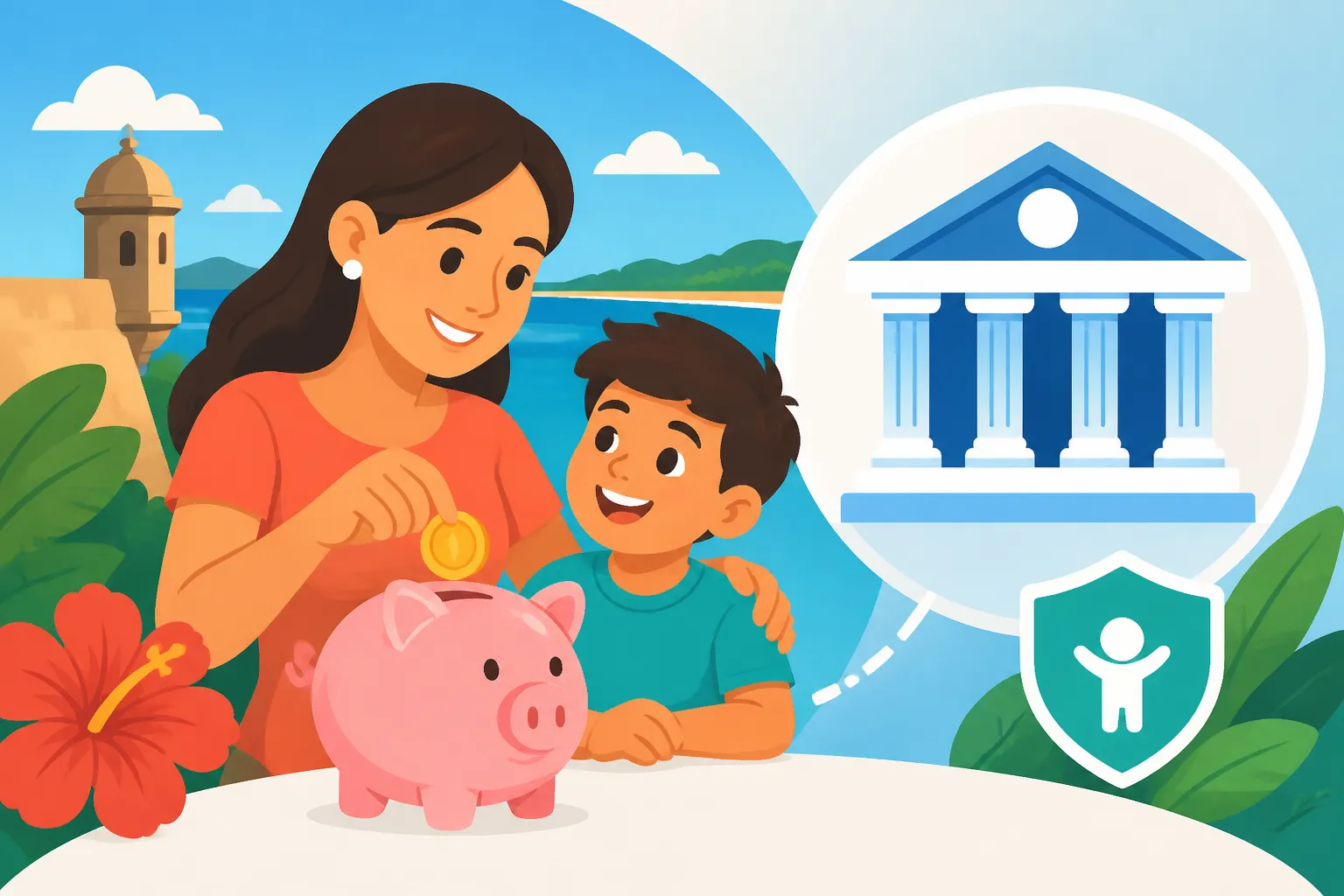
- The Hucha (Piggy Bank): Many Puerto Rican households use huchas. Incorporating this traditional method alongside a formal bank account can be a fun way to bridge cultural practices and modern banking.
Teaching your children about money in Puerto Rico isn't just about numbers; it's about helping them understand their new environment, embrace its culture, and become well-rounded, financially literate global citizens.
Table: Comparison of Child Savings Account Types
| Feature | Custodial Account (UGMA/UTMA) | Joint Account (Parent/Child) |
|---|---|---|
| Legal Ownership | Funds irrevocably belong to the child from deposit | Jointly owned by parent and child |
| Control by Parent | Custodian manages until child reaches age of majority (21 PR) | Parent maintains full control and access |
| Withdrawal Flexibility | Funds must be used for child's benefit | Funds can be used for any purpose by either owner |
| Age of Majority | Child gains full control at 21 in Puerto Rico | No automatic transfer of control at a specific age |
| Tax Implications | Income is child's, subject to "kiddie tax" rules | Income typically attributed to parent (or split) for tax |
| Complexity | Slightly more complex due to irrevocable gift rules | Simpler to set up and manage |
| Ideal For | Long-term savings for child's future, education, etc. | Teaching financial literacy, short/medium-term savings |
| Documentation | Child's SSN, Birth Certificate, Parent's ID/SSN/Proof of PR Address | Child's SSN, Parent's ID/SSN/Proof of PR Address |
Disclaimer
The information provided in this article is for general informational purposes only and does not constitute financial, legal, or tax advice. While we strive to provide accurate and up-to-date information, rules and regulations in Puerto Rico, particularly concerning banking, residency, and taxation, can change frequently and vary based on individual circumstances. We strongly recommend consulting with qualified local professionals, such as financial advisors, tax specialists, and legal counsel, to discuss your specific situation before making any financial decisions. We are not responsible for any actions taken based on the information presented herein.