How to Handle a Medical Emergency While Traveling Off-Island from Puerto Rico
You’re in Orlando for a cousin’s wedding, or on a long weekend in Santo Domingo, and suddenly you’re in an emergency room. Your Puerto Rico insurance card means nothing to the person at the front desk. This guide covers how your coverage works off-island, what to do in the first hours, how to get home safely, and how to recover what you paid.
Why Leaving the Island Changes Your Health Coverage
I learned this on a trip to Charlotte. A kidney stone sent me to an urgent care, then to a hospital. My card from a major island insurer got a long, polite stare from the registration clerk. I’m a US citizen, my plan is a US plan, and I was in the US. Yet billing treated me as if I’d arrived from another country. That gap between how Puerto Rico health insurance looks on paper and how it behaves at a mainland desk is where most of the stress comes from.
Local Networks Were Built for Local Care
Most private plans sold in Puerto Rico are designed around island providers. Your premiums, co-pays and pre-authorization rules all assume you’ll see a doctor in Hato Rey, an imaging center in Bayamón or a specialist at Auxilio Mutuo. The negotiated rates live inside that local network. Once you step outside it, the hospital has no contract with your insurer, no agreed price and often no idea how to reach anyone on your plan. For background on how these networks are built, see Understanding Provider Networks and In-Network Care in Puerto Rico.
None of this means you have no coverage. Emergency care is treated differently from routine care under most plans, and many island insurers have arrangements for members who are out of the area. The catch is that you have to activate those arrangements yourself, usually by phone, and often while you’re in pain.
The Mainland Versus International Split
The biggest single factor in how your emergency unfolds is where you are. On the mainland, in the US Virgin Islands or in another US jurisdiction, you’re protected by federal emergency rules. The Emergency Medical Treatment and Labor Act requires hospitals with emergency departments that take Medicare to screen and stabilize anyone who walks in, whether or not they can pay. You will get treated. The fight is over the bill afterward.
In the Dominican Republic, on a cruise ship, in Mexico or in Europe, that federal protection doesn’t exist. Private hospitals in Santo Domingo or Punta Cana may ask for a deposit or a credit card guarantee before admitting you. Many island plans offer little or no coverage abroad, and Medicare generally doesn’t pay for care outside the US at all. Your preparation should look very different depending on which side of that line your trip falls.
What Your Puerto Rico Plan Actually Covers Off-Island
Before any trip, find out which kind of coverage you have and how it behaves away from home. Make one phone call to your insurer’s member services line and you’ll know more than most travelers do.
Private Commercial Plans and Out-of-Area Programs
If your plan comes through an employer or you bought it yourself, look first for out-of-area or reciprocity programs. Triple-S, for example, is a Blue Cross Blue Shield licensee. Some of its plans may give members access to Blue-affiliated providers on the mainland through the BlueCard network. Whether your specific plan includes this depends on the product, so ask directly. Ask whether there’s a separate out-of-area benefit, and whether emergency care is paid at in-network cost-sharing when you’re traveling.
Other island insurers handle travel differently. Some pay out-of-network emergency care and leave you to settle the difference with the provider. Others require you to pay upfront and submit receipts afterward. A few have partner networks in Florida, where so many Puerto Rican families live. The general differences are covered in Understanding the Difference Between Mainland and Puerto Rico Health Plans, but your own plan’s benefit booklet is the final word.
Medicare and Medicare Advantage
Original Medicare works the same in Puerto Rico as in any state. If you have Parts A and B, a hospital in Atlanta or Boston that accepts Medicare will bill it just as it would for a Georgia resident. That makes Original Medicare one of the most portable options for mainland travel. Outside the US it generally pays nothing, apart from a few narrow exceptions.
Medicare Advantage is the dominant model on the island, and it works differently. These plans are built around local networks, but federal rules require them to cover emergency and urgently needed care anywhere in the United States, even out of network. Routine and follow-up care is another matter. Some Medigap and Medicare Advantage products include a foreign travel emergency benefit, so check your evidence of coverage. For a deeper look, see Understanding Medicare Advantage Plans in Puerto Rico.
The Vital Government Plan
Vital is Puerto Rico’s Medicaid-based program. Like every Medicaid program, it is administered for the territory and works mainly inside Puerto Rico. Emergency care outside the island may be covered in principle. In practice, the mainland provider usually has to be willing to enroll with or bill the managed care organization that runs your Vital coverage, and many are not.
If you’re on Vital and travel to the mainland, carry your card and your managed care organization’s phone number. Call them as early as possible in any emergency. You’ll still receive stabilizing treatment under federal emergency rules. The billing side, though, can become a long back-and-forth. For eligibility and administration details, see Understanding Medicaid and the Vital Program in Puerto Rico.
| Coverage Type | Mainland and US Territories | Dominican Republic and Abroad | Key Action Before Travel |
|---|---|---|---|
| Private employer or individual plan | Emergency care usually covered, sometimes through out-of-area networks | Often limited or none, varies by plan | Call member services and ask about out-of-area emergency benefits |
| Original Medicare | Works at any provider that accepts Medicare | Generally not covered | Consider a Medigap policy with a foreign travel benefit |
| Medicare Advantage | Emergency and urgent care covered nationwide, routine care restricted | Only if the plan includes a travel benefit | Read the evidence of coverage section on travel |
| Vital plan | Emergency stabilization required by law, billing can be difficult | Generally not covered | Carry the managed care organization phone number |
| Travel medical insurance | Depends on how the policy defines your home country | Designed for this scenario | Check the policy’s home country and pre-existing condition terms |
Step-by-Step: What to Do When Something Goes Wrong
When it happens, your brain goes foggy, your phone battery drops, and you can’t remember your member ID. It helps to have a sequence already in your head.
The First Hour
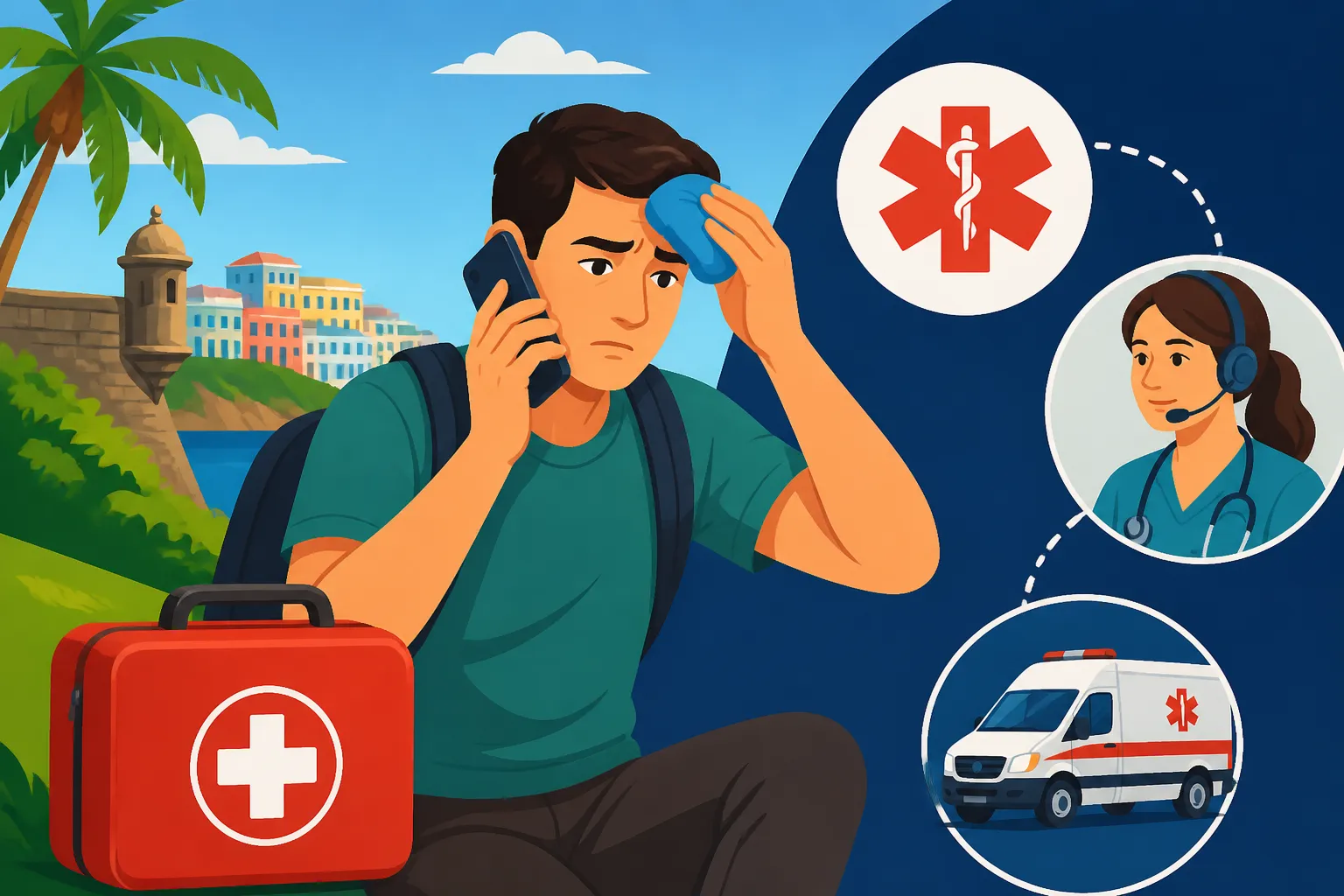
Get care first and worry about insurance second. On the mainland and in the US Virgin Islands, dial 911. In the Dominican Republic, 911 works in Santo Domingo and many tourist areas, but coverage can be patchy in rural zones. Hotel front desks there often know which private clinic to call. On a cruise, go straight to the ship’s medical center.
- Call emergency services or get to the nearest emergency department. Don’t hunt for an in-network hospital during a real emergency.
- Hand over your insurance card and a photo ID together, and say clearly that your plan is based in Puerto Rico.
- Tell staff about allergies, current medications and chronic conditions. A printed list in English is valuable here.
- Ask a companion to photograph every document you’re given or asked to sign.
- Text or call one trusted person back home with the name of the hospital and your room or bed number.
That last step sounds minor, but it isn’t. When my neighbor in Guaynabo had a cardiac event in Newark, his family spent hours not knowing which hospital he was in. One message would have saved them all that panic.
Calling Your Insurer and Getting a Case Number
As soon as you’re stable, or as soon as a companion can step out, call the member services number on the back of your card. Many plans require notification within a set window after an out-of-area emergency admission, and missing it can complicate your claim. Ask for a case or reference number, the name of the representative, and clear instructions on how the hospital should bill. Write all of it down.
If the hospital’s billing department can’t reach your insurer, give them the provider services number, which is often printed separately on the card. If English becomes a barrier on the insurer’s end, ask for a bilingual representative. Most island insurers have them, though wait times vary. A family member in Puerto Rico can sometimes make these calls for you, provided they have your member ID and date of birth.
Paying, Documenting and Keeping Paper
Abroad, and sometimes on the mainland, you may be asked to pay before you leave. If you have to pay, use a credit card rather than cash or debit. Card disputes and chargeback protections give you some leverage if billing errors show up later. Before you’re discharged, ask for an itemized bill, not just a summary statement.
Collect these before you leave the facility:
- The itemized bill with procedure codes
- The discharge summary and diagnosis
- Lab and imaging reports, or at least the results
- Prescriptions written during your stay
- Proof of payment showing date, amount and method
Keep everything in one folder or one cloud album. These are the documents your insurer will want, and getting them later from a hospital in another state can take weeks.
Getting Home Safely: Transfers and Continuity of Care
The emergency itself is often the shorter part of the story. Getting back to San Juan, and back into your normal care, can take longer and cost more than the hospital stay.
When You’re Stable Enough to Fly
After surgery, a serious infection or a cardiac event, ask your treating physician directly whether you’re fit to fly, and get the answer in writing. Airlines may ask for a medical clearance letter if you’re traveling soon after a major procedure, using oxygen or flying with a cast or mobility device. Changing a commercial flight is often far cheaper than any medical transport, so it’s worth staying a few extra days if your doctor recommends it.
If you’re on the mainland, consider whether recovering near family there makes more sense than rushing home. Many of us have relatives in Kissimmee, the Bronx or Philadelphia, and a few days on their couch can be safer than a rushed flight. If you need to coordinate a delayed return, see Can I Travel Freely Between Puerto Rico and the Mainland? for the basics of moving between the island and the mainland.
The Reality of Air Ambulances
Medical evacuation back to Puerto Rico is sometimes needed, especially from smaller Caribbean islands where specialized care isn’t available. It’s one of the most expensive services in medicine. Most standard island health plans don’t treat it as routine. Many cover it only when it’s deemed medically necessary and pre-approved, and some don’t cover it at all for a return home.
Receiving hospitals in San Juan, including the trauma and specialty services at Centro Médico in Río Piedras, can accept transfers. Transfers usually require doctor-to-doctor coordination, though, not just a patient’s request. If an air ambulance company quotes you a price, ask who is approving the transfer medically and whether your insurer has signed off. Don’t sign a financial responsibility form under pressure without understanding it.
Following Up With Your Doctor Back Home
Book a follow-up with your primary care physician or specialist as soon as you land. Bring every document you collected. Your doctor in Puerto Rico needs to know what was done, what was prescribed and what still needs monitoring. Hospital systems in different states rarely share records automatically. For how to request your own files, see How Do I Access My Medical Records in Puerto Rico?
Prescriptions written on the mainland can usually be filled at island chains like Farmacias El Amal or Walgreens locations in Puerto Rico. Your local plan’s formulary still applies, though, so a drug prescribed in Miami may need a substitute or a prior authorization here. Prescription Medications and Pharmacies in Puerto Rico: The Complete Guide covers how the pharmacy system handles this.
Building a Safety Net Before You Travel
The best time to deal with an off-island emergency is before you board. A little preparation turns a frightening ordeal into a manageable inconvenience.
Travel Medical Insurance
For trips outside the US, a dedicated travel medical policy is often the most practical safety net. Remote workers and digital nomads based in Puerto Rico often look at SafetyWing, which offers travel medical coverage for emergencies abroad on a flexible subscription model. Read how the policy defines your home country and your home-country coverage, since that affects how trips to the mainland and US territories are treated for someone living in Puerto Rico.
With SafetyWing or any comparable provider, check the provider’s own policy documents for current pricing, deductibles, coverage limits and exclusions. Pay special attention to pre-existing conditions, adventure activities like scuba diving off Culebra or the Dominican coast, and whether medical evacuation and repatriation are included. A policy that looks cheap may exclude the exact thing most likely to happen to you.
The Documents and Supplies Pack
I keep a small zip pouch that goes into every carry-on. It holds my insurance card, a photocopy of it, a printed medication list in English, my primary doctor’s contact details, and a short summary of my medical history. My phone has photos of the same documents in an offline album, because roaming data can fail just when you need it.
A good off-island pack includes:
- Physical and photographed copies of every insurance card, including any travel policy
- Your insurer’s member services and out-of-area phone numbers saved in your contacts
- A medication list with generic names, doses and the prescribing doctor
- At least a few extra days of essential medications in original pharmacy containers
- Emergency contact details written on paper, not only in your phone
For first aid basics to bring along, see What Should I Pack in a Home Medical Kit for Puerto Rico? Most of that list travels well.
Special Cases: Cruises, Weekend Trips and Remote Workers
Cruises departing from San Juan’s Old San Juan piers often stop at ports where your island plan has no presence. Ship medical centers usually bill your onboard account, and you’ll need to claim the costs back later. If you cruise often, a travel medical policy, whether from SafetyWing or another provider, is usually worth comparing against the cruise line’s own add-on insurance.
Quick trips to Santo Domingo or Punta Cana are popular because they’re short and affordable. Short trips are exactly when people skip insurance. Private hospitals in the Dominican Republic can provide excellent care, but they expect payment or a guarantee. Remote workers who split time between the island and elsewhere face a different issue: their residence and coverage can blur. If you’re in that group, see Does My Mainland Health Insurance Work in Puerto Rico? for the other side of the question.
Filing Claims and Recovering Your Money
Once you’re home and feeling better, the paperwork begins. It’s tedious, but it’s where you recover what you paid upfront.
Reimbursement From Your Insurer
Reimbursement for off-island care comes from your health insurer, or from your travel policy if care happened abroad and you had one. Each has its own claim form, submission deadline and document list. Submit promptly, because filing windows exist and they’re enforced. How to Claim Reimbursement from Your Health Insurer in Puerto Rico walks through the local process in detail.
Here’s a simple sequence that has worked for me:
- Download the claim form from your insurer’s member portal or request it by phone.
- Attach the itemized bill, discharge summary, proof of payment and your case number from the original call.
- If bills are in Spanish from a Dominican hospital, or in English for a Spanish-language form, include a short cover letter explaining what each document is.
- Keep copies of everything you send, and note the date and method of submission.
- Follow up by phone if you haven’t received an acknowledgment within the timeframe your insurer quotes.
If you hold both a local plan and a travel policy, ask each how coordination of benefits works. Usually one pays first and the other considers the remainder. Submitting to both without disclosing the other can delay or void a claim.
Appeals and Stubborn Denials
Denials happen, often for reasons that can be fixed: a missing code, a missing notification, or a claim reviewed as non-emergency because the diagnosis looked routine. Read the denial letter carefully. It must state the reason and explain your appeal rights. Ask the treating hospital for a letter of medical necessity if the emergency nature of your visit was questioned.
If an internal appeal fails, Puerto Rico’s Office of the Insurance Commissioner, the Oficina del Comisionado de Seguros, handles complaints about private insurers. Medicare beneficiaries have a separate federal appeals process. Be persistent and polite, and keep a log of every call. If you’re dealing with this right after a frightening event, it’s normal to feel worn down. Getting a family member or a patient advocate to help is perfectly reasonable.
For the broader picture of emergency care once you’re back home, including 911 response and the island’s emergency departments, see Emergency Medical Care in Puerto Rico: What Every Resident Needs to Know. Knowing the system on both sides of the trip is what makes the difference.
Disclaimer
This article is for general informational purposes only and does not constitute professional advice. Laws, prices and regulations vary by location and change over time. Consult a qualified professional for guidance on your specific situation.