How to Transfer Your Mainland Driver’s License in Puerto Rico
Your shipping container has arrived, the LUMA account is in your name, and you are still carrying the driver’s license from Ohio, Texas or New Jersey. At some point you have to swap it for a Puerto Rico one at CESCO. This guide covers that process: the documents to gather, the counter steps, the Spanish phrases that help, and the problems that send people home on their first visit.
Why Transferring Your Mainland License Matters After You Move
I put off my own license transfer for longer than I’d like to admit. Every week there was something more urgent: the internet installer who never came, the landlord who wanted the deposit in cash, the hunt for a pharmacy that stocked my prescription. The license felt like something I could handle later. Then a bank officer asked for a local ID to finish opening my account, and I learned how much on the island depends on that small plastic card.
Transferring your license is about more than staying legal behind the wheel. It is one of the main ways the Puerto Rico government, local businesses, and federal tax authorities recognize that you live here. Before getting into documents and lines, it helps to understand how the system sees you.
What Reciprocity Means for Mainland Drivers
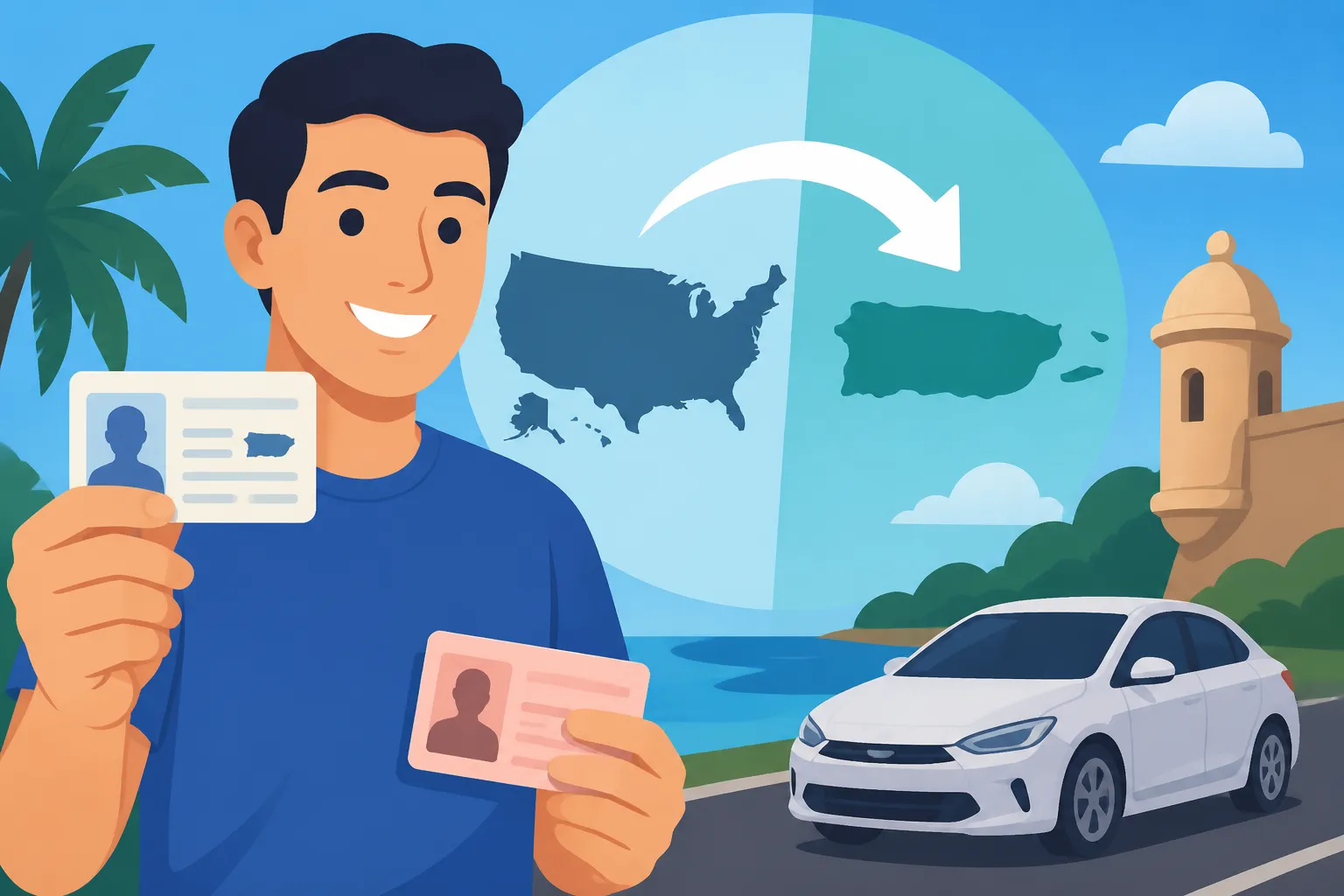
Puerto Rico is a US territory, so a valid license from any of the fifty states or the District of Columbia is treated much like an out-of-state license would be in Florida or Arizona. Puerto Rico’s Department of Transportation and Public Works, known by its Spanish initials DTOP, handles licensing through driver service centers called CESCO, short for Centro de Servicios al Conductor. Converting a valid stateside license is usually called “reciprocidad,” or reciprocity.
Reciprocity is good news. If your mainland license is valid and in good standing, you generally do not start from zero. In the standard case, you skip the learner’s permit, the theory exam on Puerto Rico traffic law, and the road test that a first-time driver faces. You are swapping one valid credential for another and showing that you meet local medical and identity requirements.
In practice, reciprocity is a paperwork exercise, not a driving exam. The difficulty is not proving you can drive. It is proving who you are, where you live, and that your home state agrees you are a driver in good standing. Those three things take most of the effort, and I cover each one below.
When You Become a Resident in the Eyes of DTOP
Visitors and residents are treated differently. A tourist on a week-long trip to Old San Juan can rent a car at Luis Muñoz Marín International Airport and drive with a stateside license without anyone blinking. Once you live here, with a lease, a job, children in school, or a home you bought in Dorado, the expectation changes. Residents are expected to hold a Puerto Rico license.
How long you can keep using the mainland card after arriving depends on your situation and on current DTOP rules. For that question, see How Long Can I Use My Mainland License Before Getting a Puerto Rico One? My practical advice is simple: once your move is permanent and you have an address you can document, start gathering papers. The longer you wait, the more likely you are to need the license urgently, for a car purchase, an insurance claim, or a rental agreement, before you have it.
Your car insurer also cares about this. If you are a resident, have an accident, and are still on a stateside license months after moving, the claim can get complicated. The insurer may ask why your documents don’t match your residence. Drivers in Guaynabo can spend weeks sorting out exactly that after a minor fender bender at a Plaza Las Américas parking garage.
How Your License Ties Into the Rest of Your Move
The Puerto Rico license is part of a chain. It often becomes the ID you use to register a shipped car, open certain local bank accounts, sign leases, pick up certified mail at the post office, and sometimes deal with utility companies. If you are registering a vehicle you brought from the mainland, it helps to have the license sorted first. For the car side, see How to Register Your Vehicle After Moving to Puerto Rico.
If you moved for tax reasons, there is another layer. For anyone establishing bona fide residency, especially under Act 60, a Puerto Rico driver’s license is one of the signals that your life is centered here. It is one of several factors in the closer connection analysis. Keeping a mainland license active works against the story you are trying to tell. For more on that, see Understanding the Closer Connection Test for Puerto Rico Residency.
If you are still early in the move and trying to sequence everything, The Complete Guide to Moving to Puerto Rico: Your First 90 Days (2027) places the license among the other early tasks so you are not doing things in an order that creates extra trips.
Documents You Need Before Visiting CESCO
This is where I want to save you a second, third, or fourth trip. CESCO staff are not trying to make your life hard, but they work under strict document rules, and they will not bend them because you drove an hour from Rincón. If one paper is missing or doesn’t match, you will be politely told to come back.
Requirements can change and vary slightly between offices. Use the list below as a working checklist and confirm the current list with DTOP or the CESCO Digital app before you go.
Identity and Social Security Proof
Start with proof of identity, which usually means an original US birth certificate or a valid US passport. Photocopies are not accepted for the core identity document. Bring the original, and don’t laminate it. A passport is often the easiest option because it is a single, widely recognized document that proves both identity and citizenship.
You will also need your Social Security number documented, usually with the original Social Security card. This is a common snag. Plenty of us filed the card away years ago, or lost it in a move. If you can’t find yours, request a replacement from the Social Security Administration before your CESCO visit. The SSA has offices in Puerto Rico, but online and mail options may be faster depending on your circumstances.
Then there is the name-matching problem, which frustrates married and divorced newcomers more than anything else. If the name on your birth certificate differs from the name on your mainland license because of a marriage, divorce, or legal name change, bring the document that links them, such as a certified marriage certificate or court order. Without that link, CESCO may not accept that the person on the birth certificate is you. Line up every document and check that the names tell one continuous story.
Proof of Puerto Rico Address
You have to show you live here, which is harder than it sounds when you’ve just arrived. Accepted proofs typically include a recent utility bill in your name, a residential lease, a mortgage statement, or similar official mail at your physical address. Real ID compliant licenses generally require more than one proof of address, so plan to bring two different documents.
The difficulty is timing. If you just moved, your first LUMA or AAA bill may not have arrived yet, or the account may be in your landlord’s name. Address this early. When you set up utilities, ask for the account in your name if possible. If you sign a lease, keep a clean copy with both parties’ signatures. A signed lease is often accepted as one of your proofs, and a bank statement mailed to your physical address can sometimes serve as a second.
Puerto Rico addresses come with their own complications. Many homes are in urbanizaciones, with addresses like “Calle 5, B-12, Urb. Santa Rosa,” and some rural addresses use kilometer markers on a road number, such as “Carr. 115 Km 12.4.” Make sure the address on your bills matches the address on your lease and on the CESCO application, character for character. If you are still sorting out how mail reaches you, especially if you rely on a PO box, see How to Set Up Your Mailing Address and USPS in Puerto Rico, because a PO box alone usually won’t satisfy a physical address requirement.
Your Certified Driving Record and Medical Certificate
This document catches people most often. CESCO typically asks for a certified copy of your driving record, sometimes called a driving history or motor vehicle record, from the state that issued your current license. It is not the same as the license. It is an official record from your home state’s DMV showing your license status, history, and any suspensions or violations. It usually needs to be recent, so ask CESCO how recently it must be issued and request it shortly before your appointment.
Most state DMVs let you order a certified record online, by mail, or in person. Online records are not always considered “certified” for out-of-state use, so check which version your state provides and whether it carries a seal or certification statement. If you can, order the record before you leave the mainland, while you still have easy access to your old address and phone number for verification. If you’ve already moved, order it online and have it mailed to a reliable address.
You will also need a medical certificate, the certificado médico. A licensed physician in Puerto Rico examines you briefly and completes a form confirming you are fit to drive, including a vision check. Clinics and doctors’ offices near many CESCO locations offer this service, often on a walk-in basis. It is usually quick, but bring your glasses or contacts if you wear them, because the vision assessment determines whether a corrective lens restriction appears on your license.
Your Document Checklist at a Glance
Use this table to check your stack the night before your appointment.
| Document | What It Proves | Original or Copy | Common Problem | How to Fix It |
|---|---|---|---|---|
| Valid US passport or original birth certificate | Identity and citizenship | Original | Laminated or damaged birth certificate | Order a new certified copy from your birth state |
| Original Social Security card | Social Security number | Original | Card lost years ago | Request a replacement from the SSA before your visit |
| Name-change documents | Link between names on different IDs | Certified copy | Missing marriage or divorce record | Order certified copies from the issuing county or court |
| Two proofs of Puerto Rico address | Physical residence on the island | Original or official printout | Utility account in the landlord’s name | Use a signed lease plus a bank statement at your address |
| Certified driving record from your home state | License status and history | Certified version | Not recent enough or not certified | Order from your state DMV shortly before your appointment |
| Current mainland driver’s license | Existing driving privilege | Original | Expired or suspended | Resolve with the home state before applying |
| Medical certificate | Fitness to drive and vision | Original form | Not completed by a licensed local physician | Visit a clinic near CESCO that offers the exam |
| Payment voucher for fees | Payment of license fees | Original | Wrong amount or wrong code | Confirm the exact fee and code before buying |
Step-by-Step: How the CESCO Transfer Process Works
Once your documents are ready, the process is manageable. The first visit can feel chaotic if you don’t know the order of operations, so here is how it typically runs from start to finish.
- Gather and double-check every document from the checklist above, making sure names and addresses match.
- Get your medical certificate from a licensed physician in Puerto Rico.
- Confirm the current fee for a reciprocity license and buy the correct payment voucher.
- Book an appointment, or turno, through the CESCO Digital app or the official DTOP channels.
- Arrive at your chosen CESCO office early, with all originals in one folder.
- Check in, explain that you are transferring an out-of-state license, and hand over your documents.
- Complete the vision check, photo, and signature capture as instructed.
- Surrender your mainland license when asked, and receive your Puerto Rico license or temporary document.
Booking an Appointment and Choosing an Office
DTOP has moved many services toward appointments, and the CESCO Digital app is the main digital tool for managing licenses, viewing records, and in many cases scheduling. Download it early and get familiar with it, since most of it is in Spanish. If you have never dealt with the system before, How Do I Register for the Puerto Rico DMV (CESCO)? walks through getting set up.
Choosing an office matters more than you might think. The San Juan metro area has CESCO locations in places like Carolina and Bayamón, and there are offices across the island in cities like Caguas, Ponce, Mayagüez, Arecibo, and Humacao. Wait times and experiences vary widely. Some newcomers in the metro area drive to an office in a smaller municipality because turnos open up faster there. If you live on the west coast near Rincón or Aguadilla, Mayagüez is the natural choice. If you are on the east side near Fajardo, Humacao or Carolina may make more sense.
A practical note: during your first weeks on the island, before you have a local phone plan, appointment confirmations and verification codes can be a headache. When I arrived, my stateside carrier’s roaming was unpredictable, and I almost missed an SMS confirmation. Some newcomers bridge that gap with a travel eSIM from a provider like Airalo, which gives them mobile data on arrival so they can manage apps and appointments until they set up a local plan. Check Airalo’s own page for current coverage and pricing before you rely on it.
Paying Fees With a Comprobante
Puerto Rico does many government payments in a way that is unfamiliar to mainlanders. Instead of swiping a card at the counter, you often pay license fees with a comprobante de rentas internas, an official payment voucher issued through Puerto Rico’s Treasury Department, Hacienda. You buy it ahead of time and bring it with you. The voucher carries a specific code and amount tied to the service you are paying for.
Buying the wrong voucher, or the right voucher for the wrong amount, is a classic first-visit mistake. Before you buy, confirm the exact service code and amount for an out-of-state license transfer, and for a Real ID compliant license if you are getting one, since those can differ. Comprobantes have traditionally been sold at colecturías, the municipal collection offices, at some bank branches, and through Hacienda’s digital channels. Some CESCO offices have a nearby place to buy them, but don’t count on it.
Keep the receipt or voucher with your other originals, and photograph it in case of a dispute. If you are unsure, ask at the CESCO information window before you queue for the main counter. A two-minute question there can save you a full morning.
What Happens at the Counter
When your number is called, say clearly that you are there to transfer a license from another state. A clerk will review your documents one by one, checking names, dates, and certifications. This is the moment of truth, and it is why the checklist matters. If everything is in order, the clerk enters your information and moves you to the next stage.
You will usually do a vision verification, have your photo taken, and provide a digital signature. Depending on the office and the current production process, you may receive your new license the same day or get a temporary document while the card is produced and sent to you. Ask the clerk which applies before you leave, and check that the information on any temporary document is correct.
Read every detail on the new license before you walk away: name spelling, date of birth, address, and any restrictions such as corrective lenses. Fixing an error on the spot is much easier than coming back. For the specifics of a Real ID compliant card and how it differs, see How to Get a Puerto Rico Real ID Driver’s License.
What Happens to Your Mainland License
This part confuses people, so I’ll be direct. Plan to give up your mainland license when you receive your Puerto Rico license.
Surrendering Your Old Card
As part of the transfer, CESCO generally retains or cancels your out-of-state license when it issues your Puerto Rico license. The principle is the same one used across the United States: a person should hold only one active driver’s license at a time. You are not adding a second license. You are replacing one jurisdiction’s credential with another’s.
Before you go, take a clear photo or photocopy of both sides of your mainland license. That record helps later if you need your old license number for an insurance file, a background check, a job application form, or a records request from your home state. Once the card is gone, digging up that number can be oddly difficult.
This rule has a practical upside for anyone establishing residency. Holding a single Puerto Rico license, with no active mainland license, keeps your records consistent with your move. If you file as a bona fide resident, that consistency is useful.
Notifying Your Home State and Your Insurer
Your home state may eventually be updated about your new license through interstate driver record systems, but don’t count on that happening quickly. Contact your old state’s DMV to confirm what they need when a license holder moves away. Some states also have requirements involving vehicle registration and plates if you still have a car registered there.
Your auto insurer needs to know too. If you shipped your car or bought one locally, your policy should reflect a Puerto Rico garaging address and your new Puerto Rico license. Insurance in Puerto Rico includes a compulsory component paid with your vehicle registration, which is handled differently from most states. See Understanding Car Registration Costs and Insurance (ACAA) in Puerto Rico for how that fits with private coverage.
If you are still deciding whether to ship your car at all, compare transport options well before your license appointment. A comparison platform like Sirelo can help you see moving and shipping companies side by side, which is useful when you’re weighing a car shipment against buying a vehicle here. Check each company’s own information for current quotes and terms.
Keeping Records for Taxes and Residency
Once your Puerto Rico license is in hand, file a copy with your residency records. If you are documenting your move for tax purposes, the license issue date is a useful dated piece of evidence showing when you formally tied your driving status to the island. Keep it with your lease, utility bills, voter registration, and similar paperwork.
I keep a single digital folder labeled “proof of island life” with scans of everything: my license, my first LUMA bill, my lease, my vehicle registration, and my voter card. When a bank, an accountant, or a government office asks for something, I can find it in seconds. You will need these documents more often than you expect.
Special Situations That Complicate a License Transfer
Not everyone has a valid, clean, standard Class D license from a single state. If you fall into one of the categories below, expect extra steps and give yourself more time.
Expired or Suspended Mainland Licenses
If your mainland license has expired, the reciprocity process may not apply the same way, because reciprocity is built on transferring a valid license. Depending on how long it has been expired and on current DTOP rules, you may be asked to renew it in your home state first or to complete some or all of the testing a new driver would face. Ask CESCO directly before you assume either outcome.
If you know your license will expire soon after your move, renewing it before you leave the mainland is often the smarter choice. Many states allow early renewal, and arriving with a license that has plenty of validity left makes the Puerto Rico transfer much smoother. It is much easier to handle in your home state than to try fixing an expired license from a thousand miles away.
A suspended or revoked license is more serious. Your certified driving record will show it, and CESCO will generally not issue a Puerto Rico license while your driving privilege is suspended elsewhere. You will need to resolve the suspension with the home state first, whether that means paying old tickets, completing a required course, or meeting reinstatement conditions. Unpaid parking tickets and forgotten toll violations have stalled more than one newcomer’s transfer.
Commercial Licenses and Motorcycle Endorsements
If you hold a commercial driver’s license, the transfer involves federal commercial driving rules as well as Puerto Rico’s own requirements. Expect additional documentation, possibly a federally recognized medical card, and questions about your endorsements, such as hazardous materials. Contact CESCO in advance and ask specifically about transferring a CDL, since the requirements go beyond a standard reciprocity transfer.
Motorcycle endorsements need attention too. If your mainland license includes a motorcycle endorsement and it shows clearly on your driving record, ask whether it can be carried over in the transfer. Bring proof. If the endorsement is missing from your record or is unclear, you may have to complete the local motorcycle licensing steps separately. Many people ride scooters and motorcycles here, especially in congested areas, so if you plan to ride, sort this out at the start.
Military Members, Students and Part-Time Residents
Active-duty military members and their families stationed in Puerto Rico may be covered by different rules about keeping a home-state license, since service members are often allowed to keep their legal residence elsewhere. If that’s you, check with your installation’s legal office before doing anything at CESCO, because your status may change what you are expected to do.
Students from the mainland at schools like the University of Puerto Rico in Río Piedras or Mayagüez are in a gray area. Some keep their home state as their legal residence while studying, and others become residents. Your choice affects your license obligations, your tuition, and possibly your taxes, so decide deliberately rather than by default.
People who split time between the mainland and the island face the hardest decision. If you are still a legal resident of another state and only spend part of the year here, your obligations differ from those of a full-time resident. Pick one place as your true home and align your documents with it, because a license in one jurisdiction and a lease, bank account, and tax filing in another creates a confusing record.
Practical Tips to Make Your CESCO Visit Easier
The rules are only part of the experience. The rest is patience, preparation, and a little Spanish.
Language Help at the Counter
CESCO operates mainly in Spanish. Some staff speak English and many are kind and patient, but you should not expect a full English service experience. The forms, the signs, the number display, and the announcements will mostly be in Spanish. That is normal here, and preparing for it will make the visit much less stressful.
A few phrases help a lot. You can say “Vengo a transferir mi licencia de otro estado,” meaning “I’m here to transfer my license from another state.” If you get lost, “¿Me puede explicar, por favor?” (“Could you explain, please?”) and “¿Qué documento me falta?” (“Which document am I missing?”) will carry you a long way. Writing these on your phone or on a card in your folder works well. For building workable Spanish for situations like this, see Learning and Working in Spanish in Puerto Rico: A Practical Guide.
If your Spanish is very limited, bring a bilingual friend or neighbor. Many local residents are happy to help a newcomer through a government office, and the goodwill you build is worth having. Some people also use translation apps for short exchanges, but speak in simple, clear sentences and confirm anything important twice.
Timing, Patience and Backup Plans
Go early, and leave the rest of the day open. Even with an appointment, wait times can stretch, systems can go down, and brief power interruptions are part of life on the island. If the system goes offline while you are waiting, it is frustrating, but staff often can’t do anything about it. Bring water, a snack, a fully charged phone, and something to read.
Avoid peak times when you can. The days around holidays, the end of the month, and busy seasons tend to be more crowded. A mid-week, mid-month morning appointment is often calmer. Some newcomers deliberately book at a smaller CESCO a bit farther from home for a quieter experience, and the extra driving is often worth it.
Always have a backup plan. Bring extra copies of everything, plus one additional proof of address if you have it. If the clerk questions a document, having an alternative ready can save the visit.
Transfer Now or Wait: Weighing Your Options
If you are unsure about timing, this comparison may help.
| Approach | Advantages | Disadvantages | Best For |
|---|---|---|---|
| Transfer soon after establishing an address | Consistent records, smoother insurance, stronger residency evidence | Requires early document gathering while settling in | Permanent movers and anyone pursuing bona fide residency |
| Wait until all utilities and leases are finalized | Easier proof of address once bills arrive | Risk of needing a local ID before you have one | People still in temporary housing |
| Renew the mainland license before moving, then transfer | Avoids problems with an expiring license | Extra task before departure | Anyone whose mainland license is close to expiry |
| Keep home-state residency and do not transfer | No CESCO visit needed | Only appropriate if you are not a Puerto Rico resident | Military members or students who remain residents of another state |
The general rule holds: once Puerto Rico is genuinely your home, transfer your license promptly and keep your records consistent. For the bigger picture of driving here, including road rules, tolls, and AutoExpreso, see Driving in Puerto Rico: Licenses, Registration and Rules for Newcomers (2027). When your new license eventually needs renewing, see How Do I Renew My Puerto Rico Driver’s License?. If you’re still unsure which identity documents count, What Documents Do I Need to Get a Puerto Rico ID? covers them in more detail.
Transferring a license in a new place is a small rite of passage. It can feel like a test of patience, and some days it is one. Then one afternoon you leave a CESCO office with a card that has the Puerto Rico seal on it, and it starts to feel like you actually live here.
Disclaimer
This article is for general informational purposes only and does not constitute professional advice. Laws, prices and regulations vary by location and change over time. Consult a qualified professional for guidance on your specific situation.