Understanding the Marbete (Vehicle Sticker) and Inspection in Puerto Rico
Moving to a new place always comes with its share of administrative headaches, and getting your vehicle squared away in Puerto Rico is certainly one of them. For many of us who’ve made the leap, the local vehicle registration and inspection process can feel like a maze, especially with the unique terminology and specific local requirements. This guide is here to walk you through everything you need to know about the Marbete (vehicle sticker) and the mandatory inspection, ensuring you drive legally and confidently on the island’s beautiful roads.
What Exactly is the Marbete in Puerto Rico?
When you first arrive in Puerto Rico and start getting your affairs in order, you’ll quickly realize that driving here has its own set of rules and quirks, much like many other aspects of life. One of the most fundamental requirements for any vehicle on the road is the Marbete. But what exactly is it, and why is it so crucial?
More Than Just a Sticker: Understanding Its Purpose
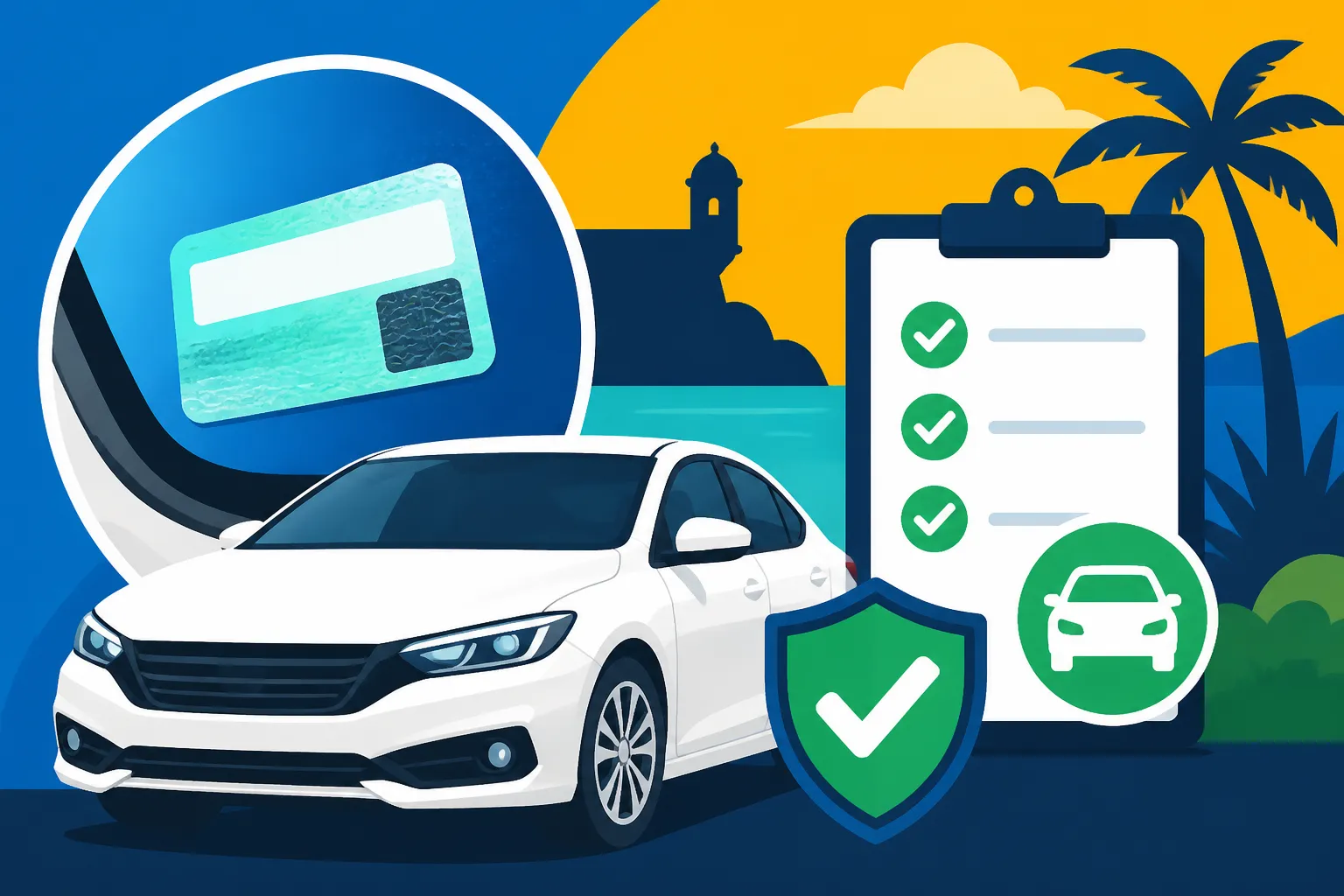
In its simplest form, the Marbete is the annual vehicle registration sticker you display on your windshield. However, its significance goes far beyond merely being an aesthetic decal. Think of it as your vehicle’s annual passport to legality on Puerto Rico’s roads. This little sticker serves as official proof that your vehicle has met all the necessary annual requirements to operate. It signifies that your vehicle has been inspected for safety and emissions, and crucially, that you have paid the mandatory public liability insurance, known locally as ACAA (Administración de Compensaciones por Accidentes Automovilísticos). Without a current Marbete, your vehicle is considered unregistered, uninsured (at least for the mandatory portion), and illegal to drive.
The Marbete system is designed to ensure that all vehicles on the road are safe, at least minimally insured, and accounted for by the Department of Transportation and Public Works (DTOP) and the Vehicle Services Center (CESCO). It’s an integrated system, meaning when you pay for your Marbete, you’re simultaneously renewing your registration and securing that basic ACAA coverage. This streamlines a process that, in other places, might involve multiple separate steps. However, it also means that if one part of the equation is missing – say, a failed inspection – you won’t be able to get your Marbete at all.
The Legal Implications of an Expired Marbete
Driving with an expired Marbete is, quite simply, a no-go. The consequences can range from inconvenient to downright costly. If you’re stopped by law enforcement, and your Marbete is expired, you’re looking at significant fines. These aren't just minor penalties; they can quickly add up, especially if your sticker has been expired for an extended period. Beyond the monetary penalties, there’s the very real possibility of your vehicle being impounded. Imagine being pulled over on your way to work or a weekend beach trip, only to have your car towed away. That’s a headache you definitely want to avoid.
Moreover, the ACAA insurance that’s bundled with your Marbete provides crucial, albeit basic, coverage for accident victims regardless of fault. This is not comprehensive coverage, mind you – you’ll still need to secure additional private insurance for that – but it’s the mandatory baseline. If your Marbete is expired, that mandatory ACAA coverage is also expired. This means that if you’re involved in an accident, you could be personally liable for costs that the ACAA would normally cover, even if it’s just the initial medical attention for injured parties. This can lead to immense financial strain and legal complications, turning an already stressful situation into a full-blown crisis. Always remember, the Marbete is more than just a sticker; it's a testament to your compliance and responsibility as a driver in Puerto Rico.
Demystifying the Vehicle Inspection Process
Before you can even think about getting your shiny new Marbete, your vehicle needs to pass a mandatory inspection. This process, often referred to as la inspección, is Puerto Rico’s way of ensuring that every vehicle on the road meets certain safety and environmental standards. It’s an annual rite of passage for all car owners here, and understanding it is key to a smooth renewal.
What the Inspection Covers: Safety and Emissions
The vehicle inspection in Puerto Rico is primarily focused on two critical areas: safety and emissions. These inspections are conducted at authorized private inspection stations, often small garages or service centers scattered throughout the island. You’ll see signs for Inspección de Vehículos or Centro de Inspección everywhere once you start looking.
When you bring your vehicle in, the inspectors will meticulously check several key components to ensure they are in good working order. On the safety front, this includes your brakes, tires (for wear and proper inflation), lights (headlights, tail lights, turn signals, brake lights), windshield wipers, horn, and mirrors. They’re looking for anything that could pose a danger on the road, not just to you, but to other drivers and pedestrians. For example, if your brake lights aren’t functioning, or your tires are bald, your vehicle will fail the inspection. Similarly, they’ll check for excessive smoke from the exhaust, which indicates a potential emissions problem. Puerto Rico takes its environmental concerns seriously, and vehicles that contribute unduly to air pollution won’t pass muster.
Many newcomers get a little nervous about this process, especially if their Spanish isn't fluent. Don't fret too much. Most inspection centers are accustomed to dealing with a diverse clientele. While it helps to have some basic Spanish, the process is fairly straightforward. Just drive in, explain you're there for an inspección, and they'll guide you. It's often quicker if you go during off-peak hours, like mid-morning on a weekday. The goal isn't to trick you; it's genuinely to ensure vehicles are safe.
Finding an Authorized Inspection Station and What to Expect
Finding an authorized inspection station is usually not difficult. As mentioned, they are plentiful and often marked with clear signage. You can also ask local friends or colleagues for recommendations, or simply search online for Centro de Inspección de Vehículos Puerto Rico in your area. Many gas stations and mechanic shops also offer inspection services.
When you arrive, the process is generally as follows:
- Queue Up: You’ll likely pull into a designated lane for inspections.
- Present Documents: The inspector will ask for your vehicle’s registration (the existing Certificado de Título y Registro or licencia del vehículo).
- The Inspection Itself: An inspector will guide your vehicle onto a designated area or lift, and proceed with the visual and functional checks. They’ll usually test your lights, brakes (sometimes using a dynamometer), check fluid levels, tire pressure, and exhaust. The whole process typically takes about 15-20 minutes, sometimes less if they aren’t busy.
- Results: If your vehicle passes, you’ll receive an Inspección de Vehículos certificate, often a small slip of paper or a digital record. This document is absolutely essential for obtaining your Marbete. If it fails, they’ll give you a list of deficiencies that need to be addressed. You'll need to get those repairs done and then return for a re-inspection. Don't throw away the failed inspection slip; it often has important information for the re-inspection process.
It’s not uncommon for minor things to cause a failure, like a burned-out headlight bulb or a cracked windshield that obstructs vision. The key is to address these issues promptly. Remember, the inspection is valid for a limited time (usually 60 days, but always check the date on your certificate), so don't delay getting your Marbete once you've passed. Trying to get your Marbete with an expired inspection certificate means starting all over again, and nobody wants that.
Decoding the Costs and Required Documents for Your Marbete
Alright, you've passed the inspection (hooray!). Now comes the part where you gather your paperwork and prepare to open your wallet. Understanding the documents you need and the costs involved is crucial for a smooth Marbete renewal, preventing those frustrating moments of being turned away at CESCO or your local bank.
Essential Documents You Must Present
The Puerto Rico vehicle registration process, while streamlined, is quite particular about documentation. You absolutely must have these items in hand when you go to get your Marbete:
- Vehicle Registration (Licencia del Vehículo / Certificado de Título y Registro): This is the existing registration document for your vehicle. It's typically a green card, and it contains all the pertinent information about your car, including the make, model, year, VIN, and your name as the registered owner. Think of it as your car's ID card. If you're a newcomer who has just purchased a vehicle here, you'll have a temporary registration or the initial title document. If you're bringing a vehicle from the mainland, the process is slightly different as you'll first need to title and register it at CESCO before you get to the Marbete stage. You can read more about that in our guide on How to Register and Title a Vehicle (DTOP/CESCO) in Puerto Rico.
- Passed Vehicle Inspection Certificate: The paper or digital proof that your vehicle successfully passed the mandatory safety and emissions inspection. This is non-negotiable. No inspection, no Marbete. Make sure it's current and hasn't expired since you got it.
- Identification: A valid government-issued photo ID. For most expats, this will be your Puerto Rico driver’s license. If you're very new, perhaps your US passport or mainland driver's license might be accepted, but it's always best to have your local ID.
- Proof of Private Insurance (Optional, but highly recommended): While the Marbete includes the basic ACAA public liability insurance, most drivers opt for additional private insurance to cover damages to their own vehicle, theft, or higher liability limits. If you have this private insurance, it's a good idea to bring proof (your policy declaration page or ID card) as some payment centers may ask for it, or it can be useful to confirm your full coverage.
It's a good practice to make copies of all these documents. You never know when an original might get misplaced or when a backup is needed.
Breaking Down the Costs Involved
The cost of your Marbete isn't a single flat fee; it's a combination of several charges. You can expect to pay around $85 to $100 annually for the Marbete itself, but this is a general figure and can vary slightly based on vehicle type and any additional fees.
Let's break it down:
- ACAA Insurance Premium: The ACAA (Administración de Compensaciones por Accidentes Automovilísticos) provides mandatory basic coverage for medical expenses and lost wages for individuals injured in traffic accidents, regardless of who was at fault. The premium for this is usually around $35 to $40 per year. This is a non-negotiable part of your Marbete.
- Vehicle Registration Renewal Fee (Derechos de Registro): This is the actual fee for renewing your vehicle's registration with DTOP/CESCO. This amount typically ranges from $50 to $60 annually, again, depending on the type of vehicle.
- Inspection Fee: This is a separate cost paid directly to the authorized inspection station. It's usually a small fee, around $11 to $15, and you pay it when your vehicle passes the inspection. This isn't included in the Marbete sticker price itself, as it's a service performed before you even apply for the sticker.
- Additional Insurance (Optional, but smart): Beyond the mandatory ACAA, most residents opt for additional private insurance coverage. This provides protection for collision damage, theft, vandalism, and higher liability limits. Prices for this vary wildly based on your vehicle, driving record, coverage levels, and the insurer. Companies like MAPFRE, Universal, and Triple-S are popular choices. This is where you really need to do your research, as the cost can easily be hundreds or even thousands of dollars per year. Our guide on Understanding Car Registration Costs and Insurance (ACAA) in Puerto Rico delves deeper into these options.
Example Scenario:
Let's say you drive a fairly standard sedan. Your annual breakdown might look something like this:
- Inspection Fee: $15 (paid to inspection station)
- ACAA Premium: $38
- Registration Renewal Fee: $55
- Total for Marbete (sticker): $93
- Total out-of-pocket (including inspection): $108
- Plus your private comprehensive insurance (e.g., $800/year, not included in Marbete)
Table: Estimated Marbete & Inspection Costs (Annual)
| Item | Estimated Cost (USD) | Paid To | Notes |
|---|---|---|---|
| Vehicle Inspection Fee | $11 – $15 | Authorized Inspection Station | Paid at the time of inspection, before Marbete application. |
| ACAA Insurance Premium | $35 – $40 | Included in Marbete purchase | Mandatory public liability insurance. |
| Vehicle Registration Renewal | $50 – $60 | Included in Marbete purchase | Annual fee for registering your vehicle with DTOP/CESCO. |
| Total Marbete Sticker Cost | $85 – $100 | CESCO, Bank, Collection Ctr. | This is what you pay when you get the sticker. |
| Total Annual Minimum (approx) | $96 – $115 | Includes inspection fee and Marbete sticker. | |
| Private Comprehensive Insurance | $500 – $3,000+ | Private Insurer | Optional but highly recommended for full coverage. |
Knowing these costs upfront can help you budget accordingly and ensure you have sufficient funds when it's time to renew. Don't forget that many banks and some larger supermarkets offer Marbete renewal services, which can save you a trip to CESCO.
The Annual Renewal Cycle: Keeping Your Marbete Current
Just like clockwork, that little sticker on your windshield will need renewing every year. The annual renewal process for your Marbete in Puerto Rico follows a fairly predictable cycle, tied to your vehicle's registration date. Staying on top of this ensures you avoid fines and keep your vehicle legally compliant.
Understanding Renewal Dates and Grace Periods
The due date for your Marbete renewal is typically based on the last digit of your vehicle's license plate number. This system helps to distribute the workload at CESCO offices and other collection centers throughout the year, rather than having everyone renew at once.
For example, if your license plate ends in a '1', your Marbete might be due in January. If it ends in a '6', it might be June. While there are general guidelines, the exact month your Marbete expires is printed right there on the sticker itself, usually in the bottom right corner. Always double-check this date! It’s your ultimate reference.
Puerto Rico does typically offer a grace period for renewals. This means that if your Marbete expires on the last day of a given month, you usually have until the last day of the next month to renew without incurring penalties. For instance, if your sticker says "Expires 01/26" (January 2026), you generally have until February 28th (or 29th in a leap year) to renew without facing late fees. However, this grace period is precisely that – a grace, not a guarantee. It's always best practice to renew before the official expiration date to completely avoid any risk of fines or complications. Relying on the grace period can be risky, especially if you forget or unforeseen circumstances delay your renewal.
Another crucial aspect of the renewal cycle is the timing of your vehicle inspection. Remember, your inspection certificate has its own expiration date, usually 60 days from the date it was issued. You must get your vehicle inspected before you can renew your Marbete, and that inspection certificate must still be valid when you go to make the renewal payment. So, plan accordingly: get your inspection done a few weeks before your Marbete expiration date to give yourself ample time.
Where and How to Renew Your Marbete
The good news is that renewing your Marbete is one of the more straightforward administrative tasks you’ll encounter as an expat in Puerto Rico. You have several convenient options:
- CESCO Offices: These are the official Vehicle Services Centers. While they are the ultimate authority, they can also be the busiest. If you choose to go to CESCO, prepare for potential wait times, especially mid-month or towards the end of a grace period. Going early in the morning, right when they open, is often your best bet. Make sure you have all your documents neatly organized.
- Banks: Many banks in Puerto Rico are authorized to process Marbete renewals. This is often the quickest and most hassle-free option. Major banks like Banco Popular de Puerto Rico and Oriental Bank routinely offer this service. You’ll typically go to a teller or a designated area for payments. You'll still need your vehicle registration and valid inspection certificate.
- Cooperative Credit Unions (Cooperativas): Similar to banks, many cooperativas also offer Marbete renewal services. These can sometimes have shorter lines than the larger banks.
- Authorized Collection Centers / Supermarkets: Certain large supermarkets or government collection centers might also have a dedicated counter for Marbete renewals. This can be super convenient if you’re already running errands.
The process, regardless of where you go, is pretty much the same:
- Present your valid vehicle registration (the green card).
- Hand over your current, passed inspection certificate.
- Show your photo ID.
- Pay the required fees (cash or debit card are usually accepted; credit card acceptance can vary).
- Receive your new Marbete sticker, which you'll then affix to your windshield, usually covering the old one.
It’s always a good idea to keep your renewed vehicle registration and a copy of your new Marbete receipt in your car, along with your private insurance information. For those moving to Puerto Rico and trying to get all their documents in order, services like Sirelo can help with coordinating the move of belongings, but when it comes to the nitty-gritty of local vehicle registration, it's about navigating these specific local agencies and payment points. Staying organized and proactive will make your annual renewal a breeze, letting you get back to enjoying all the incredible experiences Puerto Rico has to offer.
Navigating Common Issues and Avoiding Penalties
Even with all the information in hand, things can sometimes go awry. Newcomers, especially, might stumble upon unexpected challenges when dealing with vehicle registration in a new territory. Being prepared for these common pitfalls and understanding how to avoid penalties can save you a lot of grief (and money!).
What Happens If You Miss the Deadline?
Missing your Marbete renewal deadline, even with the grace period, can lead to immediate and accumulating penalties. The primary consequence is a fine for driving with an expired Marbete. This fine is usually a fixed amount, but it can increase with each month the registration remains expired. The specific amounts can change, but it's often a base fine plus an additional fee for each month of delay. For example, you might face a base fine of $50, plus $50 for each month or fraction of a month your registration is expired, maxing out at a certain amount. This can quickly become a significant sum if you let it lapse for several months.
Beyond the fines, a law enforcement officer has the discretion to impound your vehicle if they catch you driving with an expired Marbete. Getting your car out of impound is not only expensive (towing fees, daily storage fees) but also an enormous hassle. You'll need to pay all outstanding fines, get a valid Marbete, and then deal with the impound lot's release procedures. This whole ordeal can easily run into hundreds of dollars and consume an entire day (or more) of your precious time.
Another subtle but significant penalty for an expired Marbete involves the ACAA insurance. As previously discussed, the mandatory ACAA coverage is intrinsically linked to your valid Marbete. If your sticker is expired, your ACAA coverage is also expired. This means that in the event of an accident, even if it's a minor fender-bender, you could be found personally liable for the initial medical expenses of anyone injured, which the ACAA would normally cover. This exposes you to considerable financial risk and potential legal headaches. So, it’s not just about avoiding a ticket; it’s about maintaining essential protections.
Troubleshooting and Tips for Newcomers
Navigating the Marbete and inspection process can feel daunting for those fresh off the plane, but a few proactive steps and tips can make it much smoother.
- Language Barrier: While many CESCO employees and bank tellers speak English, especially in metropolitan areas, it’s not guaranteed. Having a basic grasp of Spanish phrases related to car registration ("Quiero renovar mi marbete," "Necesito la inspección," "licencia del vehículo," "seguro") or bringing a Spanish-speaking friend can be incredibly helpful.
- "What if my inspection fails?" Don't panic. The inspection station will provide you with a detailed list of what needs to be fixed. Take your vehicle to a trusted mechanic, get the repairs done, and then return to the same inspection station for a re-inspection. Often, if you return within a short period (e.g., 15-30 days), they may only re-check the specific items that failed, rather than performing a full re-inspection. Keep your failed inspection slip!
- Lost Registration (Licencia del Vehículo): If you lose your green vehicle registration card, you'll need to go to CESCO to get a duplicate before you can renew your Marbete. This requires a valid ID and potentially proof of ownership. This is why having copies or digital photos of important documents is always a good idea.
- Purchasing a Used Vehicle: When buying a used car in Puerto Rico, ensure the previous owner’s Marbete is current at the time of sale. You'll be responsible for the Marbete renewal when it next comes due. The transfer of title and registration at CESCO is a separate, crucial step you’ll undertake when purchasing a vehicle, and you won't be able to get a new Marbete until the car is properly registered in your name. If you're new to the island, our guide on How to Buy a Car as a Newcomer in Puerto Rico can walk you through the entire process.
- Stay Informed: The rules and regulations for vehicles can sometimes change. Keep an eye on local news or official DTOP/CESCO announcements. Follow reputable expat forums or social media groups for Puerto Rico, as fellow residents often share updates and tips.
- Proactive Planning: Mark your Marbete expiration date on your calendar with an alert for a month prior. This gives you time to schedule an inspection, address any potential issues, and then head to your preferred renewal spot without feeling rushed. A stress-free Marbete renewal means more time enjoying the island life!
By understanding the requirements, knowing where to go, and being prepared for common issues, you can confidently keep your vehicle properly registered and enjoy exploring every corner of Puerto Rico.
Disclaimer
Please note that the information provided in this guide is for general informational purposes only and does not constitute legal, financial, or professional advice. While we strive to keep the information up-to-date and accurate, regulations and procedures in Puerto Rico, particularly concerning vehicle registration and associated fees, can change without prior notice. It is always recommended to consult with the official Department of Transportation and Public Works (DTOP) and Vehicle Services Center (CESCO) of Puerto Rico, as well as local legal or financial professionals, for the most current and personalized advice regarding your specific situation.