Can I Walk Into a Private Hospital Without an Appointment in Puerto Rico?
You’ve got a fever that won’t break, a kid with a suspicious ankle after a fall at the beach in Isla Verde, or a nagging chest pain at 9 p.m. You’re new here, your plan card may not have arrived, and you have no idea whether you can just show up at Ashford or Auxilio Mutuo. This guide covers when walking in works, when it doesn’t, and what to bring.
The Short Answer: Yes for Emergencies, Usually No for Everything Else
The first time I needed care in Puerto Rico, I spent twenty minutes in my car outside a hospital in Santurce. I was trying to work out whether I was “allowed” to go in. Nobody tells you how things work here, and the system looks like the mainland until suddenly it doesn’t. So let’s separate the doors, because a private hospital in Puerto Rico is really several different services sharing one building.
Private Emergency Rooms Accept Walk-Ins Around the Clock
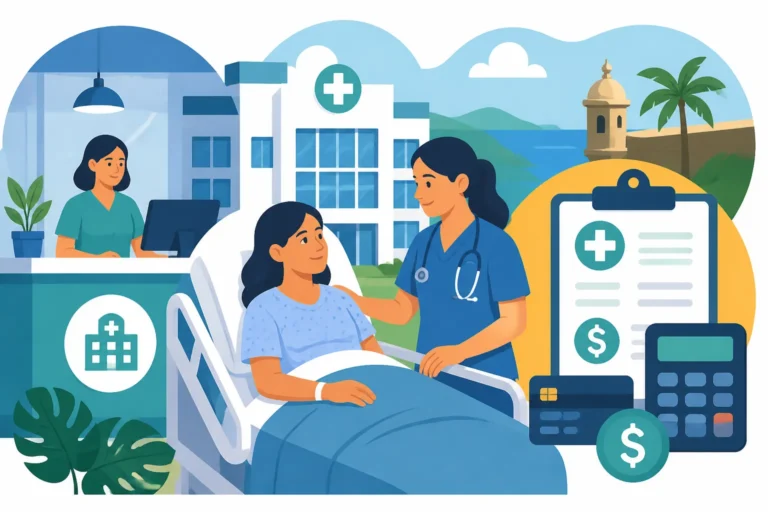
Every major private hospital on the island runs a sala de emergencia, and you do not need an appointment to use it. You walk in, register at the front desk, and get triaged by a nurse. This is true at Ashford Presbyterian in Condado, Auxilio Mutuo in Hato Rey, Hospital Pavía in Santurce and Hato Rey, HIMA San Pablo in Bayamón and Caguas, Doctors’ Center Hospital in Manatí and its other locations, Hospital Menonita in Cayey and Caguas, and Hospital Damas or Hospital Episcopal San Lucas in Ponce.
Puerto Rico is a US territory, so the federal emergency treatment law known as EMTALA applies to hospitals that participate in Medicare. In practical terms, a hospital emergency department must give you a medical screening exam. If you have an emergency condition, it must stabilize you, whether or not you have insurance and whether or not you can pay on the spot. That is the floor. Billing comes later, and it can be painful, but you will not be turned away at the door for lacking a plan card.
Picture this. You’re staying in a furnished rental in Ocean Park, and your partner wakes up with intense abdominal pain on the right side. You don’t need to call anyone first or find a referral. You drive to the nearest ER or call 911, and the triage nurse decides how fast you’re seen based on how sick your partner is, not on when you arrived. For the bigger picture of how emergency services work here, see Emergency Medical Care in Puerto Rico: What Every Resident Needs to Know.
Specialist Clinics and Outpatient Services Usually Need a Cita
Here’s where newcomers get frustrated. Many private hospitals have medical towers attached, such as the professional buildings next to Auxilio Mutuo or the offices around Ashford. Those towers house cardiologists, dermatologists, orthopedists and dozens of other specialists. Those offices are usually independent practices, not hospital departments, and most of them want a cita, an appointment.
The same goes for imaging, scheduled lab work, physical therapy and outpatient procedures run by the hospital. Showing up at the radiology desk with a doctor’s order and no appointment tends to get you a polite “vuelva mañana” (come back tomorrow) or a slot several days out. Some labs inside or near hospitals take walk-ins for basic blood work in the early morning, but MRIs, CT scans and ultrasounds almost always go through scheduling. Many plans also require pre-authorization for them.
Your health plan may add another layer. Under many Puerto Rico plans, especially managed-care and Medicare Advantage products, a specialist visit needs a referido from your primary care doctor. If you skip it, the specialist may see you as a cash patient or ask you to come back with the referral. The process is explained step by step in How Do I Get a Specialist Referral in Puerto Rico?.
The Island Habit of First Come, First Served
This one surprised me more than anything. Plenty of doctors’ offices in Puerto Rico, including some in hospital towers, work por orden de llegada, by order of arrival. You show up, sign your name on a list at the reception window, and wait your turn. Sometimes the office opens its doors well before the doctor arrives, and the waiting room fills early.
So in some cases you really can walk in without an appointment, just not at the hospital itself. It’s a cultural thing. Older, established practices, especially general practitioners, internists and pediatricians outside the San Juan metro, often run this way. Newer practices and those with a large English-speaking patient base more often use scheduled appointments, online booking or WhatsApp confirmations.
The only reliable way to know is to call. Ask directly: “¿Atienden por cita o por orden de llegada?” (Do you see patients by appointment or by order of arrival?). If you’re trying to get seen today, see Can I See a Doctor on the Same Day in Puerto Rico? for practical options.
Choosing the Right Door When You Need Care Fast
Walking into a private ER for something minor is allowed. It’s also often the slowest and most expensive option you have. Triage means a sprained wrist waits behind car accident victims and cardiac patients, and in busy metro ERs on a weekend night that wait can stretch for many hours. Matching your problem to the right door saves time, money and a lot of sitting under fluorescent lights.
Comparing Your Walk-In and Appointment Options
| Type of Care | Walk-In Without Appointment | Best Used For | What to Bring | How the Cost Usually Works |
|---|---|---|---|---|
| Private hospital emergency room | Yes, open around the clock | Chest pain, stroke signs, severe injuries, breathing trouble, high fever in infants | Photo ID, plan card, medication list | ER copay or deductible under your plan; uninsured patients are billed after screening |
| Urgent care or after-hours clinic | Yes, during posted hours | Minor cuts, sprains, ear infections, UTIs, flu symptoms | Photo ID, plan card | Usually a lower copay than the ER; cash rates vary by clinic |
| Doctor’s office working por orden de llegada | Yes, during office hours | Routine illness, follow-ups, prescription renewals | Photo ID, plan card, referral if required | Office visit copay or a set cash fee |
| CDT public diagnostic and treatment center | Yes for urgent services at many locations | Non-life-threatening urgent issues, especially outside the metro area | Photo ID, plan card if you have one | Often lower cost; depends on plan and municipality |
| Specialist office in a hospital tower | Usually no | Cardiology, dermatology, orthopedics, ENT | Referral, plan card, prior test results | Specialist copay; may need pre-authorization |
| Hospital imaging and outpatient procedures | Rarely | MRI, CT, ultrasound, scheduled procedures | Doctor’s order, pre-authorization, ID | Coinsurance or copay per your plan |
| Telehealth through your plan or provider | Yes, on demand with many services | Rashes, colds, prescription questions, triage advice | Phone or computer, plan details | Often a low copay or included in plan benefits |
When the ER Is the Right Call
Don’t second-guess yourself into a dangerous situation. Go straight to an emergency room, or call 911, for any of the following:
- Chest pain, pressure or pain spreading to the arm, jaw or back
- Sudden weakness, facial drooping, slurred speech or confusion
- Difficulty breathing or choking
- Severe bleeding or a deep wound
- Head injury with vomiting, drowsiness or loss of consciousness
- High fever in a young infant, or a fever with a stiff neck
- Severe allergic reaction with swelling of the lips or throat
- Signs of severe dehydration, which is a real risk in the island heat
- Possible broken bones with visible deformity
For serious trauma, ambulance crews often take patients to the Centro Médico complex in Río Piedras, which houses the island’s main public trauma center. That is not a private hospital, but it’s where the most critical cases often end up, regardless of insurance. Private ERs handle a huge volume of everything else.
If you’re torn between the big San Juan hospitals, each has its own strengths, neighborhood and English-language comfort level. The trade-offs are compared in How Do I Choose Between Auxilio Mutuo, Pavia and Ashford Hospitals?.
When Urgent Care or Telehealth Makes More Sense
Let’s say it’s Sunday afternoon in Dorado and your teenager has a painful earache. That’s not an emergency. Driving into the metro and spending the evening in a private ER waiting room is technically allowed, but it’s overkill. An urgent care clinic or after-hours practice will usually see you faster and charge you less under your plan.
Urgent care has grown a lot across the metro area and in towns like Bayamón, Caguas, Guaynabo and Carolina. Hours vary widely. Some clinics close early on Sundays, and holiday schedules can be unpredictable, especially around Christmas, which runs long in Puerto Rico. Call ahead or check the clinic’s social media page, which local practices often update more faithfully than their websites.
Telehealth is the other underrated option. Many local plans include virtual consults, and a doctor can often tell you over video whether you need to be seen in person. That alone can save you a wasted trip. The options are described in Can I Get a Telehealth Appointment in Puerto Rico?.
What Happens When You Walk Into a Private ER
Knowing the sequence ahead of time takes a lot of the anxiety out of the experience. Registration in Puerto Rico is paperwork-heavy and mostly conducted in Spanish, though staff at the big San Juan hospitals regularly deal with English speakers.
The Step-by-Step Walk-In Process
Here’s roughly what to expect at a typical private emergency room:
- Registration at the front desk. You give your name, date of birth, photo ID and plan card. Without a plan card, you’ll be registered as self-pay or asked for whatever coverage details you have.
- Triage. A nurse takes your vital signs, asks about symptoms and assigns a priority level. This decides your place in line, so be specific and honest about how you feel.
- Waiting. This is the part nobody enjoys. Lower-priority patients can wait a long time, especially in metro hospitals during evenings, weekends, holidays and respiratory virus season.
- Physician evaluation. An emergency physician examines you and orders tests if needed, such as blood work, X-rays, an EKG or a CT scan.
- Treatment or observation. You may receive IV fluids, medication or a procedure, or be held for observation while results come back.
- Disposition. You are discharged with instructions and prescriptions, admitted to the hospital, or transferred to another facility if a specialty service is needed.
- Billing and paperwork. Insured patients usually pay the ER copay or are billed later. Self-pay patients may be asked for payment or a payment arrangement before leaving.
Bring a phone charger and water, and if possible, a friend who speaks Spanish. Waits can be long, and having someone to handle the registration questions while you focus on feeling terrible makes a big difference.
Documents and Items to Have Ready
I keep a small zip folder in my car’s glove box with copies of everything below, and it has saved me more than once:
- Government photo ID, such as a driver’s license or passport
- Your health plan card, front and back, or a photo of it on your phone
- A written list of current medications, doses and allergies
- Names and phone numbers of your primary care doctor and any specialists
- Any recent test results or discharge papers related to the current problem
- An emergency contact who can be reached easily
If you’re on a plan that requires referrals, bring your primary doctor’s information. The ER team may need to coordinate follow-up care. A fuller checklist is in What Documents Do I Need to See a Doctor in Puerto Rico?.
Getting By in Spanish at the Front Desk
The big hospitals in San Juan, particularly Ashford in Condado, regularly serve tourists, expats and Act 60 residents, so you’ll usually find someone who speaks English. Outside the metro, in places like Cayey, Arecibo or Mayagüez, you might find yourself working through registration in Spanish with a patient but busy clerk.
A few phrases help enormously:
- “Necesito ver a un médico de emergencia.” I need to see an emergency doctor.
- “Me duele aquí.” It hurts here, while pointing to the spot.
- “Soy alérgico a (name of medication).” I am allergic to (name of medication).
- “¿Aceptan mi plan médico?” Do you accept my health plan?
- “¿Alguien habla inglés?” Does anyone speak English?
Doctors in Puerto Rico are often bilingual because many trained on the mainland, and medical vocabulary in Spanish overlaps heavily with English. Still, a language barrier feels very different when you’re scared and in pain. If you want an English-speaking regular doctor so that follow-ups go smoother, see How to Find an English-Speaking Doctor in Puerto Rico.
Insurance, Payment and What It Costs You
Walking in is easy. Paying for it is where many newcomers lose sleep, so let’s go over how money works at a private hospital door.
If You Have a Local Plan
Puerto Rico’s private insurance market is dominated by local carriers such as Triple-S, MCS, MMM and First Medical, along with Medicare Advantage products. Most cover emergency room visits with a fixed copay or a deductible. Hospital networks matter: a plan may favor certain hospitals for non-emergency services, while emergencies are typically covered at any ER.
If you end up admitted, things change. Inpatient stays usually involve a separate admission copay or coinsurance, and your plan may need to be notified within a short window. The hospital’s admissions office usually handles that call, but it’s smart to confirm it happened. The admission process is covered in detail in Understanding Hospital Admission and Billing in Puerto Rico.
Your plan’s own website and member services line will have the current copay amounts for ER, urgent care and admissions. Check your benefit summary before you need it, not while you’re sitting in triage.
If You Have Mainland Insurance or Travel Coverage
Mainland plans are hit or miss here. Some national carriers have reciprocity arrangements or out-of-network emergency coverage that works in Puerto Rico. Others treat the island as out of area for everything except true emergencies. The ER will usually accept your card for registration and bill your insurer, but you may get balance billing or reimbursement delays afterward.
For digital nomads, remote workers on extended stays and visitors, travel medical insurance often fills the gap. SafetyWing is one of the options people in my circle use while they figure out long-term coverage, because it’s designed for travelers and remote workers rather than residents of one specific place. With policies like SafetyWing, you’ll often pay the hospital directly and then submit a claim with your itemized bill, discharge summary and receipts. Read the policy wording carefully, especially around emergency definitions, pre-existing conditions and how long you can be outside your home country. Check SafetyWing’s own policy page for current coverage terms rather than relying on secondhand summaries from other travelers.
Whatever coverage you hold, ask the hospital for an itemized bill and a copy of your medical records before you leave or shortly after. Insurers, including SafetyWing and mainland carriers, typically want documentation that clearly shows diagnoses and procedures.
If You Are Between Plans or Uninsured
This is the scary scenario, and it happens a lot to people in their first weeks on the island. Your mainland plan ended, your employer plan here hasn’t started, or you’re still comparing local options. Then something happens.
The emergency screening and stabilization rule still protects you. You will be seen. What changes is the bill: you’ll be registered as self-pay, and the hospital may ask for a deposit or payment arrangement, especially if you’re admitted. Ask the billing office about self-pay discounts, prompt-payment discounts and installment plans. Private hospitals here do negotiate, particularly when you approach them politely and early.
For the bridge period itself, some newcomers carry short-term travel coverage like SafetyWing until local insurance kicks in, as long as their situation fits the policy’s eligibility rules. For a full game plan covering what to do if you fall ill during that gap, see What Happens If I Get Sick Before My Insurance Starts in Puerto Rico?.
How the final bill is calculated, and how much an ER visit can set you back with and without insurance, is covered in How Much Does an Emergency Room Visit Cost in Puerto Rico?.
A Few Hard-Won Tips Before You Need Them
After years here and more ER visits than I’d like to admit, these are the habits I recommend to every friend who moves to the island:
- Find your nearest ER and urgent care now. Do a dry run on a quiet day so you know where to park, which entrance to use and how long the drive really takes in traffic.
- Save your plan’s member services and nurse line numbers in your phone. Many local plans run a nurse hotline that can tell you whether to go to the ER, urgent care or wait for your doctor.
- Establish care with a primary doctor early. Having a doctor of record makes referrals, prescriptions and follow-ups after an ER visit far easier.
- Photograph your plan card and ID. Wallets get left behind in the panic of an emergency.
- Keep a printed medication and allergy list. Hand it over at triage and you’ll answer half the questions in one go.
- Expect long waits for minor problems. Pack patience, snacks, water and a charger, and save the ER for things that truly need it.
- Ask for copies of everything before leaving. Discharge notes, test results and itemized bills are much harder to get weeks later.
Walking into a private hospital in Puerto Rico without an appointment is absolutely possible when it’s an emergency, and the law ensures you’ll be screened and stabilized. For everything else, the island runs on citas, referrals and the quirky first-come-first-served system at many doctors’ offices. Once you know which door to knock on, getting care here becomes a lot less intimidating.
Disclaimer
This article is for general informational purposes only and does not constitute professional advice. Laws, prices and regulations vary by location and change over time. Consult a qualified professional for guidance on your specific situation.