Do I Need a Work Permit to Work in Puerto Rico?
Picture this: you’ve landed a job offer in San Juan, your lease in Condado is signed, and the night before your start date you panic. Do you need a work permit to work in Puerto Rico? Should you have applied for something months ago? This guide explains who needs work authorization, who doesn’t, and which local paperwork employers actually request.
The Short Answer: Puerto Rico Follows US Federal Work Rules
I remember asking a version of this question when I first moved down. Spanish is everywhere, the license plates say “Isla del Encanto,” and the culture feels nothing like Ohio or New Jersey. It felt foreign, so I assumed I needed some kind of foreign paperwork.
I didn’t. Puerto Rico is a US territory, and immigration and work authorization here are governed by federal law, the same system that applies in Texas or Oregon. There is no separate “Puerto Rico work permit” issued by the island government for adult workers. What decides whether you can legally work is your status under US immigration law.
That single fact settles most of the anxiety. The rest of the paperwork is about licensing, background checks and tax registration, and that part is genuinely local. Let’s take it group by group.
US Citizens, Including People Born in Puerto Rico
If you are a US citizen, you can work in Puerto Rico exactly as you could in any state. No visa, no permit, no sponsorship, no special registration with an immigration office. People born in Puerto Rico are US citizens by birth, so the same applies to returning Boricuas who spent years in Orlando, the Bronx or Chicago.
Here is what that looks like in practice. Say you’re a nurse from Philadelphia who accepts a job at a hospital in Hato Rey. On your first day, HR asks for the same identity documents they’d ask for in Pennsylvania, usually your passport, or your driver’s license together with your Social Security card. You fill out Form I-9 like any other American worker, and that’s it for immigration. Your nursing license is a separate matter, and I’ll get to it below, but nobody is going to ask you for a visa.
Many people lose sleep over this, sometimes because a well-meaning relative told them Puerto Rico is “another country.” It isn’t, for work purposes. For a fuller breakdown, see Can I Work in Puerto Rico as a US Citizen Without a Visa?
Green Card Holders
Lawful permanent residents can live and work in Puerto Rico just as they can on the mainland. Your green card is your work authorization, and it works the same way in Ponce as it does in Phoenix. Moving here is not leaving the United States, so it does not count as abandoning your US residence the way a long stay in, say, Spain might.
The practical wrinkle is travel. Flights between Puerto Rico and the mainland are domestic, so you won’t pass through immigration on those routes. Even so, carry your green card when you fly, because airlines and TSA treat it as identification. If you’re flying in from abroad, say from the Dominican Republic or Europe, you’ll clear US Customs and Border Protection at Luis Muñoz Marín International Airport, the same process as at Miami or JFK.
One scenario I’ve seen more than once is a green card holder from Colombia who marries a Puerto Rican, settles in Bayamón, and assumes they need something extra to work locally. They don’t. The rules are the same as stateside, including renewing the card on time. For more detail, see Can Green Card Holders Live in Puerto Rico?
Foreign Nationals and Tourists
This is where the answer flips from “no” to “yes, absolutely.” If you are not a US citizen or permanent resident, you need valid US work authorization to work in Puerto Rico. That could be an employment-based visa such as an H-1B, L-1 or O-1, or an Employment Authorization Document issued by US Citizenship and Immigration Services. These are federal documents, processed through the same federal channels as anywhere else in the country.
Tourist status does not allow work. This trips people up constantly, especially Europeans who arrive under the Visa Waiver Program and fall in love with Rincón or Vieques. You might find a beach bar that’s happy to pay you cash to cover shifts, but that doesn’t make it legal, and it can seriously damage your future US immigration prospects. The same goes for “volunteering” at a surf hostel in exchange for room and board, which can still count as unauthorized work.
If you hold a UK passport and are planning a scouting trip, see Do British Citizens Need a Visa to Visit Puerto Rico? If you’re thinking about a longer-term move from outside the US, see Understanding How Foreign Nationals Can Live in Puerto Rico, which walks through the visa pathways in more depth.
Here’s a summary of where each group stands:
| Who You Are | Need a Work Permit or Visa? | What You Show Your Employer | Local Extras to Expect |
|---|---|---|---|
| US citizen from the mainland | No | Form I-9 documents such as a passport, or a driver’s license plus Social Security card | Possible background check certificate, professional license if your field is regulated |
| US citizen born in Puerto Rico | No | Form I-9 documents | Same as above |
| Green card holder | No separate permit; the green card is your authorization | Permanent resident card for Form I-9 | Same as above |
| Foreign national with a work visa | Yes, federal work visa required | Visa-related documents for Form I-9 | Same as above, plus credential validation if your degree is foreign |
| Foreign national with an EAD | Yes, the EAD is the permit | Employment Authorization Document | Same as above |
| Tourist or Visa Waiver visitor | Cannot work | Not applicable | Not applicable |
| Minor of any citizenship | Youth employment permit through the Puerto Rico Department of Labor | Permit plus Form I-9 documents | Parental consent and school-related documents |
The Local Paperwork Employers Actually Ask For
Once the immigration question is answered, the next surprise for most newcomers is how much paper Puerto Rican employers like to collect. None of it is a “work permit” in the immigration sense, but if you show up without it, your start date can slip. I learned this the hard way when my first local job delayed my onboarding by a week because I didn’t have a certificate I’d never heard of.
Form I-9 and Your Social Security Number
Every employer in Puerto Rico must verify identity and work eligibility through Form I-9, just as on the mainland. Some employers also use E-Verify. If you already have a Social Security number, nothing changes. Your number works here because the Social Security Administration is a federal agency with offices on the island, including in San Juan and other major municipalities.
If you’re a foreign national with new work authorization and no Social Security number yet, you’ll apply for one through the Social Security Administration once your status allows it. Your employer can usually start the onboarding process while the number is pending, but payroll will want it as soon as possible.
Payroll here has its own local features. Puerto Rico has a separate income tax system run by the Departamento de Hacienda, so your withholding works differently from what you’re used to in a state. Your W-2 equivalent is a local form called the Comprobante de Retención. For how that works, see Understanding Payroll Taxes and Withholding for Employees in Puerto Rico
The Certificate of Good Conduct and the Health Certificate
This is the one that caught me. Many Puerto Rican employers, especially in healthcare, education, security, government and childcare, ask for a Certificado de Antecedentes Penales, often called the “certificado de buena conducta.” It’s a criminal background certificate issued through the Puerto Rico Police Bureau, and in many cases you can request it online through the government’s digital services portal. It’s quick once you know about it. You just don’t want to discover it at 4 p.m. on the Friday before your Monday start.
If you’ve lived on the island only briefly, some employers will also ask for a background check from your previous state. Ask HR directly which version they want, because practice varies by employer and sector.
The second document is the certificado de salud, a health certificate. Food handlers, restaurant staff, school employees and many people working with children or patients are commonly asked for one. You get it from a licensed clinic or laboratory, and it usually involves basic tests. Plenty of clinics in strip malls across Carolina, Guaynabo and Caguas advertise it on handwritten signs out front. You’ll start noticing them once you know what to look for.
Professional Licenses and Colegios
If your profession is regulated, such as nursing, medicine, engineering, accounting, real estate, cosmetology or many trades, your mainland license usually does not transfer automatically. Puerto Rico has its own examining boards, known as juntas examinadoras, and some professions also involve a professional association called a colegio. The process, the exams and whether there’s a Spanish-language component depend on the field.
Think of a licensed electrician from Florida who moves to Dorado. Working for a contractor here is perfectly legal from an immigration standpoint. But taking on electrical work under his own name, without the local license, is not. It’s the same logic as moving from Florida to Georgia, with an extra layer of Spanish-language bureaucracy.
Start this process before you move if you can, because it is often the slowest piece of the puzzle. For the full walkthrough, see How to Get a Professional License to Work in Puerto Rico
Work Permits for Minors
There is one situation where Puerto Rico does issue something called a work permit: employment of minors. Teenagers who want summer jobs at a mall in Plaza Las Américas or a fast-food chain in Mayagüez typically need a youth employment permit processed through the Puerto Rico Department of Labor and Human Resources, known locally as the DTRH. Parental consent and school information are usually part of the application. There are also limits on hours and on the kinds of work minors can do.
If you’re relocating with a teenager who’s eager to earn money, look up the DTRH’s current requirements before they start applying. Employers here take youth hiring seriously, and a reputable one will ask for the permit before scheduling a single shift.
Self-Employed, Freelancers and Remote Workers
A huge share of the newcomers I meet don’t take a local job at all. They freelance, run a small business, or keep a remote job with a company in Austin or Seattle. For US citizens, none of these situations requires a work permit either. They do, however, come with registration obligations that work a lot like permits in practice, and skipping them causes real headaches later.
Registering Your Business Activity Locally
If you sell goods or services in Puerto Rico as a sole proprietor or through a company, you’ll generally need to handle several local registrations:
- A Merchant Registration Certificate, the Registro de Comerciante, tied to sales and use tax, known locally as IVU
- A taxpayer account with the Departamento de Hacienda through the SURI online portal
- A municipal license tax, the patente municipal, with the municipality where you operate
- Any professional license your field requires, as described above
The Registro de Comerciante is the one people most often describe as a “business permit,” and many clients and landlords will ask to see it. Local businesses are also legally expected to display it at their place of business. For the steps, see How to Get a Merchant Registration (Registro de Comerciante) in Puerto Rico
Hacienda registration is the other foundational step, and SURI takes some getting used to. It is mostly in Spanish, and its error messages are cryptic. For a walkthrough, see How to Register with Hacienda and Get a Tax Account in Puerto Rico
Here’s an everyday scenario. A graphic designer from Atlanta moves to Santurce and starts picking up clients at local coworking spaces. Her mainland clients just pay her invoices, but when a local restaurant group hires her for a rebrand, their accounting department asks for her Registro de Comerciante and may withhold tax at source. Without the registration in place, the payment stalls. Nothing about her immigration status changed. She simply hadn’t set up her local business identity yet.
Working Remotely for a Mainland Employer
Remote work is the area where I get the most questions, and the honest answer is that it’s legal and common. A US citizen can live in Puerto Rico and keep working for a company in New York without any permit. Your employer doesn’t need permission from anyone on the island to employ you here.
What changes is the tax and HR side. Some mainland companies aren’t set up for Puerto Rico payroll and treat the island like a foreign location in their systems, even though it isn’t. Others handle it smoothly. Before you book movers, get written confirmation from HR that they’re comfortable with you being based here, and ask how they’ll handle withholding. See Can I Work Remotely from Puerto Rico for a Mainland Company? for the questions to raise with your employer.
Taxes are where remote workers get hurt. If you become a bona fide resident of Puerto Rico but your employer keeps withholding as if you live in your old state, you can end up filing with Hacienda and the IRS in ways that are genuinely confusing, especially in the year you move. A few people I know who split the year between Chicago and San Juan hired an online expat tax service like Taxes for Expats to sort out the mix of Puerto Rico and mainland income. That’s the kind of situation where specialized help can pay for itself. Check the provider’s own site for what’s included and how they price it.
Act 60 Decrees Are Tax Incentives, Not Work Permits
Because Act 60 gets so much attention, I want to be precise here. An Act 60 decree is a tax incentive agreement with the government of Puerto Rico. It gives you no immigration status, no visa and no work authorization. A foreign national with an approved decree still needs proper US immigration status to live and work here.
Act 60-2019, the Puerto Rico Incentives Code, contains two programs that newcomers mix up all the time. As of October 2026, here’s how they’re set up in the consolidated text:
| Program | Where It Sits in Act 60 | Former Law | Core Tax Treatment |
|---|---|---|---|
| Export Services | Chapter 3, Section 2031.01 | Formerly Act 20 of 2012 | Eligible export services income taxed at a fixed 4% under Section 2032.01(a) |
| Resident Individual Investor | Chapter 2, Section 2021.01, with benefits in Sections 2022.01 and 2022.02 | Formerly Act 22 of 2012 | Depends on when the decree application is filed; see below |
For the Resident Individual Investor decree, Act 38-2026 amended Sections 2022.01 and 2022.02. As of October 2026, the rules are:
- Decree applications filed on or before 31 December 2026 keep the 0% exemption on interest, dividends and gains accrued after the move, through 31 December 2035.
- Decree applications filed from 1 January 2027 pay a fixed 4% on interest, dividends and post-move gains, until 2055, and the applicant must show at least six years of non-residence in Puerto Rico before the move.
- Resident Individual Investor decree holders must donate at least $10,000 a year to Puerto Rico non-profit organizations under Section 6020.10(b).
If you run a consulting or service business that serves clients off the island, start with the Export Services decree. See Understanding Act 60 (Export Services) Benefits for Businesses in Puerto Rico Either way, keep the two ideas separate in your head: your immigration status decides whether you can work, and your decree, if you have one, decides how certain income is taxed.
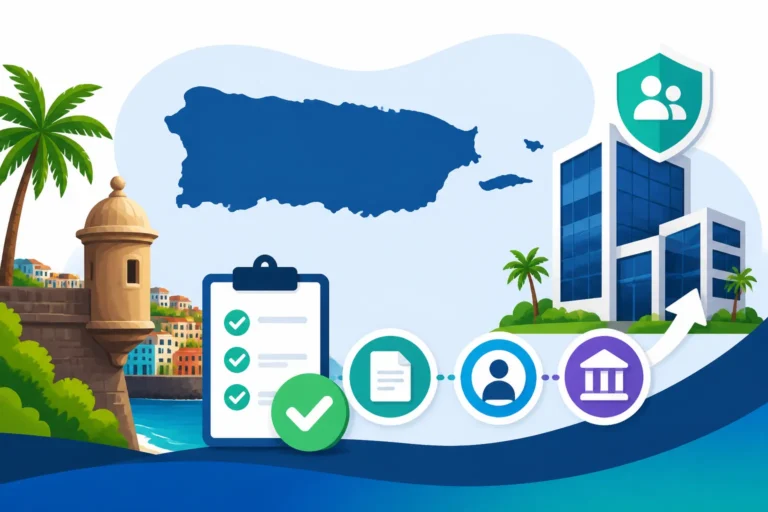
A Practical Checklist Before Your First Day of Work
Here’s the sequence I wish someone had handed me when I moved. It assumes you’re a US citizen or green card holder; foreign nationals should put step one at the very top and make sure it’s fully resolved before anything else.
- Confirm your federal work eligibility. For citizens and green card holders this is automatic. For everyone else, it means an approved visa or Employment Authorization Document in hand.
- Gather your Form I-9 documents. That means a valid passport or passport card, or a driver’s license together with your Social Security card. Bring originals, not photocopies.
- Ask HR in writing which local certificates they require. The usual candidates are the Certificado de Antecedentes Penales and the certificado de salud.
- Request the background certificate as early as possible, and book the health certificate exam at a licensed clinic if your role needs one.
- Check whether your profession is regulated in Puerto Rico. If it is, contact the relevant junta examinadora and start the license process long before your start date.
- If you’ll be self-employed, register with Hacienda through SURI, obtain your Registro de Comerciante, and handle your municipal patente where you operate.
- Set up a local bank account so payroll or client payments land smoothly. Many employers here prefer direct deposit to a Puerto Rico bank.
- Talk to a tax professional about your move year, especially if you’ll have both mainland and Puerto Rico income.
- If your teenager plans to work, start the youth employment permit process with the DTRH before they apply for jobs.
Why Spanish Matters Even When English Is Enough
Technically, English is an official language in Puerto Rico, and plenty of workplaces in pharma, tech, tourism and federal agencies run largely in English. You can absolutely get hired without fluent Spanish. But the paperwork I’ve described lives mostly in Spanish. SURI, municipal offices, the police certificate portal, clinic intake forms and most junta correspondence will test your vocabulary.
I had my own moment at a CESCO office in Carolina, nodding confidently at a clerk while understanding perhaps a third of what she said. I left with the wrong form. That kind of thing happens constantly in your first year, and it’s nobody’s fault. The system just assumes you speak Spanish.
Workplace Spanish also changes how you’re perceived by colleagues. Even halting attempts at small talk in the break room go a long way. A lot of newcomers I know book a few weekly lessons with a tutor on iTalki before and after the move. It’s especially helpful if you pick a tutor who knows Caribbean Spanish, because Puerto Rican speech is fast, drops consonants and is full of local slang that textbooks never cover. Others use iTalki specifically to rehearse things like a phone call to a municipal office or a job interview in Spanish. For more strategies, see How to Improve Your Spanish for the Puerto Rico Workplace
Situations That Deserve Extra Caution
A few scenarios call for slowing down and checking twice:
- Foreign spouses of US citizens. Marrying a US citizen does not instantly grant work authorization. Until the relevant federal application is approved, your spouse cannot legally take a job, even a casual one at a family business in Arecibo.
- Dependents on employment visas. Some dependent visa categories allow the spouse to apply for work authorization and others don’t. Check the specific category with an immigration attorney before assuming either way.
- Cash work in tourism. Beach rentals, tour boats and bars in tourist zones sometimes offer informal arrangements. For anyone without work authorization, these carry real immigration risk, and for citizens they still carry tax and liability exposure.
- Licensed professionals starting before the license arrives. Working under supervision may be allowed in some fields and prohibited in others. Get the junta’s answer in writing, because a verbal “it should be fine” from a recruiter isn’t protection.
- Mainland contractors bidding on local jobs. Your state contractor license doesn’t carry over, and local clients and inspectors will check.
If you take one thing from my years here, let it be this: the immigration question is usually the easy part. For US citizens and green card holders, it’s essentially a non-issue. The real work is in the local layer of certificates, licenses and Hacienda registrations. None of it is hard once you know it exists, but all of it is slower than you expect. Start early, keep digital and paper copies of everything, and be patient with the offices. Puerto Rico rewards the people who show up prepared and with a little good humor.
Disclaimer
This article is for general informational purposes only and does not constitute professional advice. Laws, prices and regulations vary by location and change over time. Consult a qualified professional for guidance on your specific situation.