How Do I Find a Home Near Good Schools in Puerto Rico?
Your kids’ school is often the anchor of a family move to Puerto Rico. The trouble is that the island’s best schools are clustered in a few pockets, rentals near them go fast, and a “fifteen-minute” school run can turn into an hour on PR-2. This guide covers how to pick the school first, then find a home you can live with.
Start With the School, Not the House
Almost every family I’ve met here who regretted their housing choice did it in the same order. They fell in love with an apartment in Condado or a house in Dorado, signed a lease, and then started calling schools. By then the school they wanted had a waitlist, or it sat on the far side of the worst traffic corridor in the metro area, and the “dream home” became a daily two-hour car ride. Reverse that order and things get much easier.
Understand the Two Very Different School Worlds
Puerto Rico runs on two largely separate tracks. The public system is managed by the Departamento de Educación de Puerto Rico, and instruction is mostly in Spanish, with English taught as a subject. There are standouts in the public system. Specialized schools, the escuelas especializadas, focus on science and math, the arts, sports or bilingual instruction. The University High School in Río Piedras, run by the University of Puerto Rico, has a strong reputation and admits students by application. In general, though, public school quality varies a lot from one building to the next, and many newcomer families are not ready for a Spanish-dominant classroom.
The private track is where most English-speaking newcomers end up. Private schools range from small parish colegios to large, accredited, English-immersion college-prep campuses. They have their own admissions, their own calendars, their own transportation arrangements and their own tuition schedules. For a deeper look at how the two tracks differ, see Understanding the School System (Public, Private, Charter) in Puerto Rico.
The key thing for your house hunt is this: the school you pick decides the municipality you should live in. If you go private, your address barely affects admission, but it decides whether the school run is pleasant or awful. If you go public, your address carries more weight, because placement usually starts from where you live. Confirm the current assignment and transfer rules directly with the Department of Education before you sign anything.
Decide What “Good” Means for Your Family
“Good school” means different things to different families, so define it before you start touring. A family relocating for a couple of years who wants a seamless return to a mainland school will care most about full English instruction, US-style curriculum and recognized accreditation. A family staying long-term may want strong Spanish so the kids truly integrate. Parents of a child with learning differences need to know what support services a school actually provides, not what the brochure implies.
Then there’s infrastructure, which mainland parents rarely think about. Does the campus have a generator? Does it have air conditioning in every classroom? How did it handle the last major power outage? After a few hurricane seasons here, I put “does the school stay open when the grid goes down” on the same level as test scores.
Write down your top three non-negotiables. When you’re touring schools and apartments with jet lag and a sweaty toddler, that list will keep you honest. Schools and Education in Puerto Rico: A Complete Guide for Families covers these priorities in more detail if you’re still working out what matters most.
Know the Admissions Calendar Before You Book Flights
Private schools in Puerto Rico generally follow a school year that starts in August. Admissions for the popular campuses open well before that. Entry-year grades like pre-kindergarten and kindergarten fill first, because families who get in early tend to stay for years. Mid-year openings do happen, especially in the expat-heavy schools where families rotate out, but you can’t count on them.
The process typically involves an application, records from the previous school, a placement assessment or interview, recommendation forms and often a family meeting. Some schools ask for proof of address at a later stage, which is one more reason to line up schools and housing together. For the step-by-step on applications, see How Do I Apply for a Private School Spot in Puerto Rico?.
If admissions tells you a grade is full, ask directly about the waitlist: how many families are ahead of you, and when spots historically open up. Those answers will tell you whether to sign a lease near that school or keep a backup in mind.
Matching Neighborhoods to Schools Across the Island
Once you have a shortlist of schools, the housing search gets much more focused. Below is how the main school clusters line up with the neighborhoods where families actually live.
The Guaynabo and San Juan Metro Cluster
The heaviest concentration of English-immersion private schools is in the San Juan metro area. Commonwealth-Parkville School sits in Guaynabo, and the residential areas around it, such as Garden Hills, Torrimar and the gated urbanizaciones near Parkville, are full of families who chose them for the short drive. These neighborhoods offer single-family homes with yards, controlled access gates and a suburban feel that many mainland families find familiar.
Baldwin School is in Bayamón. Families there often look at homes in Bayamón itself or at nearby parts of Guaynabo, then test the drive carefully, because the roads between the two can clog at drop-off time. Over in the coastal part of San Juan, Saint John’s School and Robinson School are both in Condado. Families who want walkable, beach-adjacent living often look at Condado, Miramar and Ocean Park, usually renting condo apartments rather than houses.
The metro trade-off is simple: you get the widest school choice and the most services, but also the worst traffic and higher rents near the most popular campuses. How to Find Family-Friendly Neighborhoods in San Juan breaks down the individual urbanizaciones if you want to compare streets rather than whole municipalities.
Dorado and the North Coast
Dorado is the other big magnet, largely because of TASIS Dorado, an international-style school that draws many relocating families. Housing ranges from modest walk-ups in town to gated resort communities like Dorado Beach, with prices to match. Lots of families pick Dorado for a quieter, greener life that is still within reach of San Juan for work or the airport.
The catch is that Dorado’s appeal has pushed up rents and tightened inventory, especially for furnished family homes near the school. If you’re also weighing coastal towns farther west, How Do I Choose Between San Juan, Dorado and Rincon to Live In? lays out that three-way decision honestly, including the fact that the west coast has far fewer English-immersion school options.
Ponce, the West and the East
Ponce, on the south coast, has its own long-established private schools, including Colegio Ponceño and the Caribbean School. Housing there is generally more affordable than in the metro area, and families who settle in Ponce often describe a slower, more local pace of life. The trade-off is that day-to-day life, including school communication, leans more heavily on Spanish.
On the west coast, Mayagüez is the main school hub for the region. It has private colleges and is home to a university campus that anchors the local professional community. Surf towns like Rincón are wonderful places to live, but families there often drive a fair distance to school, so map that commute before you commit.
On the east side, Palmas del Mar in Humacao is a large planned community with its own school, Palmas Academy, and a self-contained lifestyle that appeals to some families and feels isolated to others.
| Area | Example Schools Nearby | Typical Family Housing | What to Watch |
|---|---|---|---|
| Guaynabo | Commonwealth-Parkville School | Gated single-family homes, townhouses | Rush-hour traffic, high demand near campus |
| Bayamón | Baldwin School | Houses in urbanizaciones, some condos | Test the drive from Guaynabo at drop-off time |
| Condado, Miramar, Ocean Park | Saint John’s School, Robinson School | Condo apartments, few houses | Parking, condo rules, flood exposure near the coast |
| Dorado | TASIS Dorado | Gated communities, resort homes, town walk-ups | Tight inventory and premium rents near the school |
| Ponce | Colegio Ponceño, Caribbean School | Houses with yards, more affordable rentals | More Spanish-dominant daily life |
| Humacao | Palmas Academy | Planned-community villas and homes | Distance from the San Juan metro |
What Private School Tuition Looks Like and How It Shapes Your Housing Budget
Tuition belongs inside your housing budget, because every dollar going to school fees is a dollar you can’t spend on rent. Families who budget for them separately often end up stretched.
The Published Numbers You Can Actually Plan Around
Of the major schools named in this guide, Commonwealth-Parkville School publishes its 2026-2027 prices on its own site, as of October 2026. Tuition starts at $7,700 for PPK and $11,600 for kindergarten. Grades 1 through 8 run $13,000 to $13,850, and grades 9 through 12 are $14,900. Once annual fees are included, the total runs from $9,130 to $16,820 a year depending on grade. New families also pay a one-time registration fee of $1,600.
TASIS Dorado, Saint John’s School and Baldwin School do not post tuition amounts on their own websites. Contact each admissions office and ask for the current-year fee schedule in writing. For Colegio Ponceño, request the current cost sheet directly from admissions. The same applies to any school not listed here.
| School | Location | 2026-2027 Tuition, as of October 2026 | Notes |
|---|---|---|---|
| Commonwealth-Parkville School | Guaynabo | PPK $7,700; Kinder $11,600; Grades 1-8 $13,000-$13,850; Grades 9-12 $14,900 | $9,130 to $16,820 a year including annual fees, plus a one-time $1,600 new-family registration |
| TASIS Dorado | Dorado | Ask admissions | No tuition amounts posted on the school’s site |
| Saint John’s School | Condado, San Juan | Ask admissions | No tuition amounts posted on the school’s site |
| Baldwin School | Bayamón | Ask admissions | No tuition amounts posted on the school’s site |
| Colegio Ponceño | Ponce | Ask admissions | Request the current cost sheet directly |
The Extras That Quietly Add Up
Tuition is the headline, but it’s rarely the whole bill. When you talk to admissions, ask about every line item: application and assessment fees, annual fees, technology or book fees, uniforms, school bus service, after-school care, field trips and parent association dues. Ask too whether there are sibling discounts, payment plans or a discount for paying the full year upfront.
School transportation matters a lot for your housing choice. Many private schools don’t run their own buses. Instead, families hire private transport services, often vans that cover certain neighborhoods. If your chosen home falls outside every route, you’re the bus. Ask admissions which neighborhoods existing transport services cover, and treat that as a strong hint about where to rent. For a fuller picture of these costs, see Understanding the Cost of Private Schools in Puerto Rico.
A Realistic Budgeting Scenario
Picture a family with a kindergartner and a third grader who want Commonwealth-Parkville. Using the published 2026-2027 schedule, add the kindergarten and grades 1-8 totals including annual fees, plus the one-time $1,600 registration for the first year, then add uniforms, transport and after-school care on top. Now take that annual figure, divide it by twelve, and look at it next to the monthly rent on homes in Garden Hills or Torrimar.
Many families find that this exercise changes their housing plan. Some move from a house to a townhouse to stay close to campus. Others choose a slightly cheaper urbanización a bit farther out and accept a longer drive. Neither choice is wrong. What matters is that you make it with the school costs already in front of you, not after the first tuition invoice arrives.
How to Actually Find and Secure the Right Home
With a school shortlist and a realistic budget, it’s time to hunt. The rental market here runs on relationships, WhatsApp messages and quick decisions, which can be a culture shock if you’re used to polished mainland listing portals.
Run a Scouting Trip Built Around School Hours
If you possibly can, come to the island before you commit to a lease, and plan the visit around the school day rather than beach time. Book school tours on weekday mornings, then view properties in the afternoon. Most important, do the actual commute at the actual time. Drive from a candidate home to the school at around 7 a.m., then back again in the afternoon pickup window. That one test has saved more of my friends from bad leases than any amount of online research.
If you’re flying in from outside the US, sort out mobile data before you land so maps and messaging work from the moment you leave the airport. An eSIM from Airalo is one easy way to do this. You’ll be messaging landlords and agents on WhatsApp all day and following live traffic between viewings, so dependable data matters more than you’d expect. Check Airalo’s own app for current regional plans that cover Puerto Rico before you travel. For a full itinerary template, see How to Plan a Scouting Trip Before Moving to Puerto Rico.
Here’s the sequence I recommend to families:
- Confirm two or three target schools and request current fee schedules and admissions timelines from each.
- Book school tours for weekday mornings during your scouting trip.
- Ask each admissions office which neighborhoods most current families live in and which areas transport services cover.
- Shortlist rentals in those neighborhoods through agents, local classifieds and parent networks.
- Drive every serious candidate home to school at real drop-off and pickup times.
- Check the property for generator access, water storage and flood exposure.
- Apply to schools and negotiate the lease in parallel, so neither one leaves you stranded.
Where Listings Actually Live
Mainland portals show only part of the market. Many Puerto Rico rentals are listed on ClasificadosOnline, a long-running local classifieds site where listings are often in Spanish, or posted in Facebook groups for specific towns and expat communities. Many of the best family homes near popular schools never get listed at all. They pass from one departing family to the next through school parent networks.
That’s why getting into the parent community early pays off. Once you’ve applied, ask admissions whether a parent ambassador or welcome committee can connect you with current families. Those parents know which landlord is responsive, which street floods in a heavy rain and which gated community has a waitlist. A local real estate agent who specializes in rentals can also earn their fee by getting you in front of properties before they’re advertised.
When you find the right place, move quickly but read carefully. Leases here often call for a security deposit plus the first month, sometimes more for furnished homes, and terms vary. Before signing, review How to Sign a Lease and Understand Tenant Law in Puerto Rico so you understand your rights on repairs, deposits and early termination. Early termination matters for relocating families whose plans can change.
Inspect for Island-Specific Must-Haves
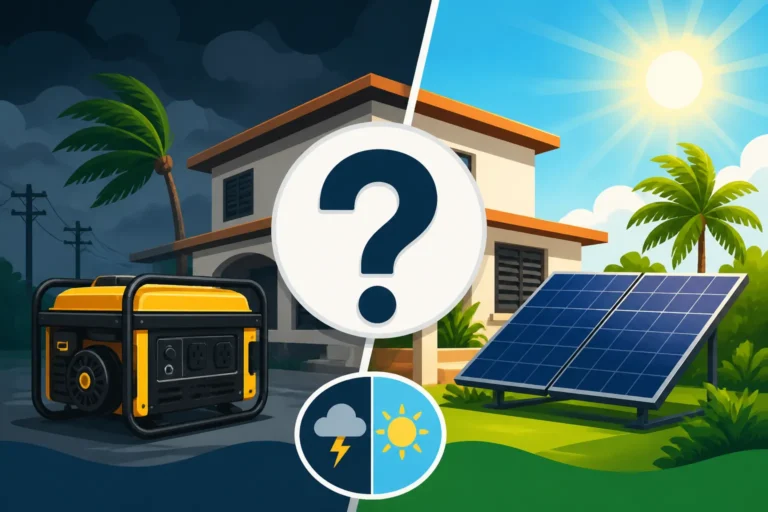
A home near a great school isn’t a good home if your kids can’t sleep through a power outage or get to school after a storm. When you view a property, ask about the electricity backup. Is there a full-house generator, a shared building generator, solar with batteries, or nothing? Ask about water as well. A cisterna, or water storage tank, keeps the taps running during service interruptions, which is a real lifesaver on school mornings. If you’re looking at apartments in the metro area, How Do I Find an Apartment with a Generator in San Juan? goes through the questions to ask building managers.
Flooding is the other big question, especially in coastal neighborhoods like Condado and Ocean Park and in low-lying parts of some urbanizaciones. Ask neighbors how the street held up during past storms, and look at whether the route to school crosses areas known to flood. Understanding Flood Zones and Hurricane Insurance in Puerto Rico explains how to check flood zone status and what it means for renters’ insurance.
Finally, consider security and lifestyle. Many families with young kids prefer gated urbanizaciones with controlled access, a guard booth and a playground or pool. These communities can come with homeowners’ association rules that bind tenants too, covering things like guest parking, noise and pets, so ask for a copy of the rules before you commit.
Coordinating the Move With the School Calendar
Timing matters too. Ideally, your lease starts a couple of weeks before the first day of school, so you can unpack, buy uniforms, practice the school run and get the kids’ sleep schedules adjusted. Shipping household goods to the island takes planning, especially if you’re moving from far away. A comparison platform like Sirelo can help you collect and compare quotes from several international moving companies in one go instead of chasing each one separately. Check each mover’s own terms for current pricing and transit times, and see How Do I Find a Reliable Moving Company to Puerto Rico? for how to vet movers.
On the school side, gather your documents early. Schools typically ask for previous report cards, standardized test results, a birth certificate and health records. Puerto Rico requires proof of immunization for school attendance, usually on the island’s official vaccination certificate, so book an appointment with a local pediatrician soon after arrival to get the paperwork transferred. Confirm current requirements with each school and with the Department of Health. For the full enrollment checklist, including public school registration, see How to Enroll Your Child in a Puerto Rico School.
If housing near your first-choice school just won’t come together in time, a furnished short-term rental can bridge the gap. Families often spend the first semester in a temporary place, get to know the area properly, and then sign a longer lease on a home they found through the parent network. It takes an extra move, but it’s far better than locking into a year-long lease in the wrong neighborhood.
Finding a home near a good school in Puerto Rico takes more patience and more local networking than many parents expect. Families who start with the school, budget honestly for tuition and test the commute at real hours tend to settle in happily. Give yourself time and ask other parents for help.
Disclaimer
This article is for general informational purposes only and does not constitute professional advice. Laws, prices and regulations vary by location and change over time. Consult a qualified professional for guidance on your specific situation.